Logo Cost
|
Mar 23, 2026
How Much Does a Logo Cost in 2026
Logo cost in 2026 ranges from free AI-powered tools to premium agency work exceeding 20000, depending on customization and deliverables. With AI now playing a major role in logo creation, businesses can generate usable designs in minutes or invest in fully custom branding systems. The right choice depends on your stage, budget, and how unique your brand identity needs to be.
How Much Does a Logo Cost in 2026?
A logo is not a decoration. It is the visual shorthand for everything your business stands for. It goes on your website, your packaging, your invoices, and the corner of every social post you ever publish. And yet, pricing for logo design in 2026 spans an almost absurd range: from completely free, to north of $100,000 for Fortune 500 brand overhauls.
So what does a realistic, useful logo actually cost? And how do you avoid paying too little and getting a template everyone else is using, or too much and funding a three-month agency engagement when you needed a mark by next Tuesday?
This guide breaks it all down with real data, honest tier comparisons, and a decision framework based on where your business actually is right now.
Quick Answer: Logo Cost in 2026
Free logo makers (Canva, AI tools)$0 — $20
Entry-level freelancers (Fiverr, Upwork)$50 — $300
Mid-range freelancers$300 — $1,500
Professional designers / boutique studios$1,500 — $5,000
Full-service design agencies$5,000 — $50,000+
According to multiple industry surveys, the most common spend for small businesses is around $500, with roughly 57% of business owners landing in that range. Only 14% report spending over $1,000. But "most common" does not always mean "most appropriate." Let's look at what each tier actually gets you.
One thing those figures rarely make clear is whether tax is included. European studios almost always quote net, so if you are weighing a German designer's fee against a US one, run it through a German VAT calculator first. Nineteen percent is often the entire difference between two quotes that look identical on paper.
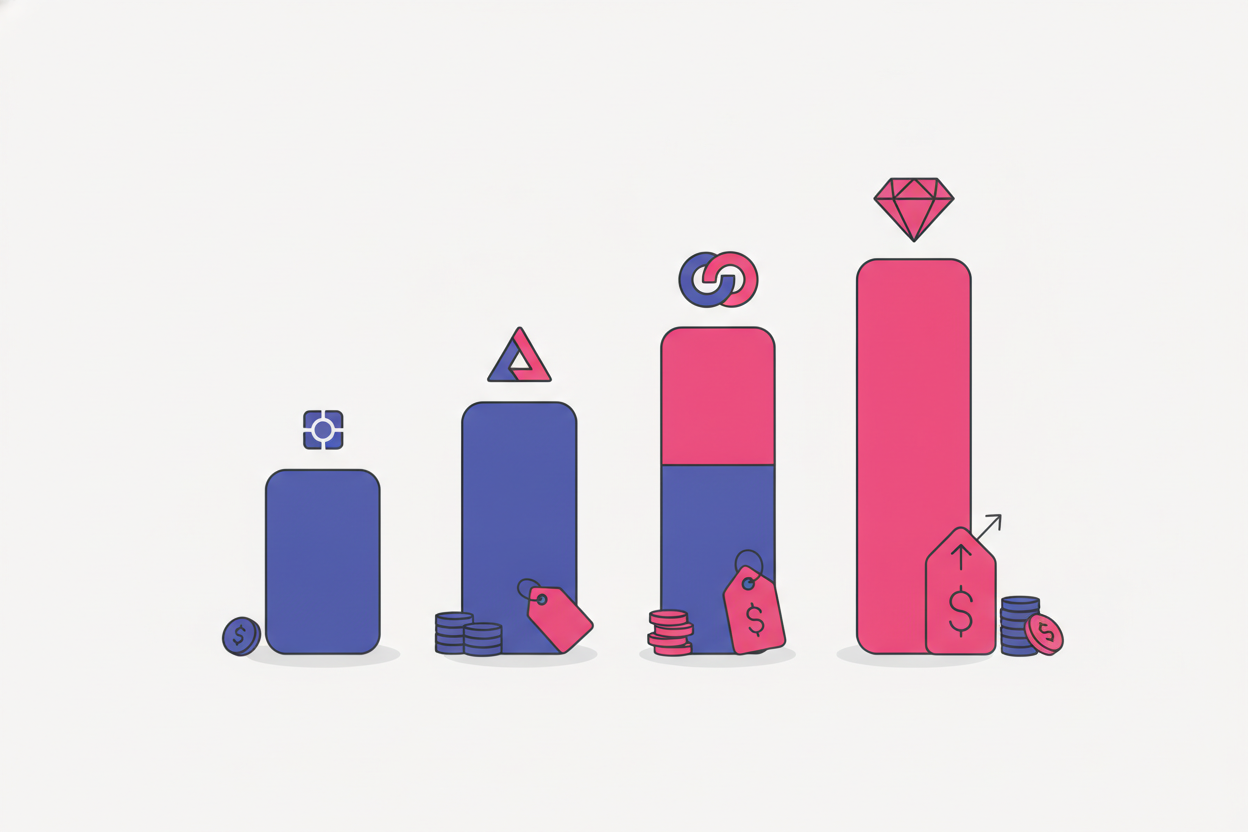
Logo Pricing by Type: What You Actually Get
Free / DIY
$0 – $20
Logo makers, Canva, AI generators. Fast but generic.
Freelancer
$50 – $1,500
Wide quality range. Personalized work. Vet carefully.
Pro Designer
$1,500 – $5,000
Strategy included. Multiple concepts. Full file package.
Agency
$5,000 – $50K+
Brand system. Research-backed. Team of specialists.
Free Logo Makers and AI Tools
Platforms like Canva, Looka, Wix Logo Maker, and AI-powered generators can get you a usable mark in under 30 minutes. For many early-stage businesses, that is genuinely fine. You are testing an idea, building a landing page, or launching something that may pivot in six months.
The hidden cost is not the subscription fee (most are $0 to $20). It is the file limitations, the lack of vector originals, and the very real chance your logo is nearly identical to another business's — because you both picked "tech startup, blue, circuit board icon" from the same template library.
Use free tools when: you are pre-revenue, validating an idea, or launching something temporary. Explore the free logo library at LogoToUse to study real brand examples for visual inspiration before you start.
A note on AI-generated logos: In 2026, AI logo tools are fast and cheap, but purely AI-generated logos still lack originality by design — they are trained on existing visual patterns. They are a good starting block, not a final destination for a brand that needs to differentiate.
Freelance Designers
The freelance tier is the widest and the most variable. On platforms like Fiverr, you can find a logo for $10. On Upwork or through direct referral, a strong mid-career designer might charge $800 to $1,500 for a full project including a brief, multiple concepts, revisions, and deliverable files.
The danger here is not price — it is misalignment. A $100 logo from an inexperienced freelancer who is copying styles they have seen elsewhere could cost you far more in a future rebrand. Look at portfolios, not prices. Ask specifically what files are included. Ask who owns the copyright on delivery.
According to data from DesignRush, freelancers in Eastern Europe and Southeast Asia typically charge between $5 and $40 per hour, making full logo projects available for $300 to $1,500 — while U.S.-based experienced freelancers commonly charge $75 to $150 per hour.
Professional Designers and Boutique Studios
This is where design shifts from "make something visual" to "build a brand asset." A professional designer at this level will typically start with a discovery session, review your competitive landscape, develop two to four genuinely distinct concepts, iterate with you through structured revision rounds, and hand off a complete file package.
The $1,500 to $5,000 range often includes a basic brand guide alongside the logo — documenting color codes, typography, and usage rules so the mark stays consistent across whoever touches it next. That guide alone is worth significant money in the long run.
Design Agencies
Agencies bring a full team: strategists, researchers, art directors, and production designers. The result is not just a logo — it is a brand system. That includes primary and secondary marks, color palettes, typography hierarchies, tone of voice, and often application mockups for packaging, signage, or digital products.
Agency work starts at roughly $5,000 and scales to $50,000 or more for established businesses or those undergoing a full rebrand. According to DesignRush, top-tier logo firms charge an average of $117 per hour, with 17.8% of agencies taking on projects under $1,000 (usually limited-scope gigs) and less than 1% requiring budgets above $50,000.
The AIGA's professional pricing guidelines for design firms emphasize fixed-fee contracts where scope is clearly defined upfront — a critical practice at this investment level.
What Affects Logo Cost: The Real Variables
Two businesses can both be quoted "a logo" and receive wildly different numbers. Here is what is actually driving those differences:
Rush fees are a real and significant cost. Designers often charge 25% to 100% on top of their base rate for expedited timelines. Need a logo in 48 hours? Plan to pay nearly double. Need it in three weeks? Standard rates apply. Build timeline into your planning budget — not just money.
Revisions are another area where costs quietly balloon. Most professional designers include two to three rounds in their quoted fee. Each additional round beyond that often carries an hourly charge. Clarify this in writing before any project starts. A clear, detailed brief upfront will save you revision rounds downstream.
Cheap vs. Expensive Logos: When Each Makes Sense
The false choice most business owners face is "cheap vs. quality." The more useful question is: what does this logo need to do, and for how long?
A $50 freelancer logo for a pop-up market stall that runs eight weekends a year is a completely rational decision. A $50 logo for a SaaS product raising a Series A is a liability: investors, potential partners, and users all form first impressions from visual identity, and a generic logo signals that brand is not a priority.
The rebrand trap: One of the most expensive mistakes in branding is buying a cheap logo, growing, and then paying for a full rebrand two years later. You pay twice, plus the cost of updating all brand assets in between. If you can see three to five years ahead for your business, invest accordingly now.
When cheap is enough: Testing a concept, launching a side project, covering a temporary need, or working in a category where visual identity matters little (certain B2B services, early-stage SaaS, local services with strong word-of-mouth).
When you need to invest: Consumer-facing brands, any business raising investment, companies in visually competitive categories (food, fashion, tech, health), or whenever your logo will appear on physical products or significant advertising spend.
You can also explore the biggest logo redesigns of 2026 to understand how established companies evolve their identities — and why.
The Decision Guide: Which Option Fits Your Business Stage?
| Business Stage | Recommended Option | Budget Range | Priority |
|---|---|---|---|
| Pre-launch / Idea stage | DIY tool or AI generator | $0 – $20 | Speed |
| Early startup (pre-revenue) | Entry-level freelancer | $100 – $500 | Budget |
| Growing startup (post-revenue) | Experienced freelancer or boutique studio | $500 – $2,000 | Quality + Value |
| Funded startup or SME | Professional designer or small agency | $2,000 – $8,000 | Brand System |
| Established company / rebrand | Full-service agency | $10,000 – $50,000+ | Strategy First |
Think about it in terms of hours of work. A budget of $500 buys roughly 10 hours of a junior designer's time or 5 hours of a senior's. After accounting for meetings, emails, and admin, that leaves three to four hours of actual design time. That is a constrained creative process — fine for simple work, limiting for anything nuanced.
Looking for logo inspiration before you brief a designer?
Browse thousands of real brand logos — colored, black, white, and iconic — organized and free to explore.
Explore Logo Examples →What Files Should Your Logo Include?
This is where many buyers get shortchanged without realizing it. A logo is not a single image file. A professional logo delivery is a package of different formats optimized for different use cases. Here is what you should always ask for:
Essential
.SVG
Vector (scalable)
Scales infinitely. Use for websites, print, anything. The master file.
Essential
.PNG
Transparent background
Web, social media, overlays. Request multiple sizes.
Useful
.JPG
Flat backgrounds
Email signatures, documents, non-transparent contexts.
Pro tier
.AI / .EPS
Editable source
Future editing, printing at any size. Ask for this always.
Useful
.PDF
Print-ready
Printers, signage vendors, and press often require PDF format.
Always ask
Dark + Light
Variants
White version for dark backgrounds, dark for light. Both are essential.
If a freelancer is delivering only a JPG or a low-resolution PNG, that is a red flag. You will eventually need the vector source — for a signage printer, for a merchandise run, for a website developer. Getting it upfront avoids paying again later.
You should also ask for variations: a horizontal version, a stacked version, and an icon-only version (the "favicon" form) for use at small sizes like browser tabs and app icons.
If you are curious about how real brands use their logos across different backgrounds and contexts, exploring black logo variants is a useful reference for how a well-constructed identity adapts to any surface.
What about AI-generated logos in 2026? AI tools like those built on diffusion models and generative vector pipelines can produce polished-looking marks quickly. But most cannot reliably deliver a true scalable SVG, guarantee uniqueness, or provide the copyright clarity you need. For a detailed breakdown of the tradeoffs, see our piece on AI-generated logos vs. human designers.
How to Save Money on Logo Design Without Cutting Corners
Good news: there are legitimate ways to reduce cost without compromising the final result. These strategies work at any tier.
Write a detailed brief before you make first contact. Every hour a designer spends discovering what you want is an hour billable to your project. A brief that covers your industry, target audience, competitors, visual preferences, and what you want the logo to communicate shortens the entire process — and reduces revision rounds significantly.
Limit the number of initial concepts you request. Three concepts are typically enough to find a direction. Requesting five or six slows everything down and costs more without meaningfully improving outcomes.
Use templates for early-stage, then upgrade. There is nothing wrong with a quality template logo while you validate your business model. Budget for a professional logo in year two once you know the business is working and what it has become.
Choose an experienced generalist over a niche specialist for early work. A designer who specializes in luxury hotel branding will charge accordingly, even for a small project. A strong generalist with a solid portfolio delivers comparable results for simpler briefs at lower cost.
Ask about package deals. Many designers bundle logo work with brand guidelines, business card design, or social media asset kits. The bundle price is almost always lower than the sum of parts.
Clarify revision limits in writing. Agree on exactly how many revision rounds are included in the quoted fee, and what happens if you need more. This one step eliminates the most common source of scope creep and unexpected invoices in creative work.
If you are thinking through design trends before commissioning work, the comparison between flat and 3D logos is a practical reference for deciding on visual direction.
Do You Own Your Logo After Buying It?
This is one of the most overlooked questions in logo purchasing — and the answer is: not automatically.
Copyright in a design defaults to its creator. When you commission a logo, you need an explicit transfer of intellectual property rights in your contract. Without that clause, the designer retains copyright and could legally restrict how you use the logo, resell similar designs, or create complications if you ever need to register a trademark.
Always confirm in writing that you receive full, unlimited rights to the final design upon payment. For businesses planning to register a trademark (a smart move for consumer-facing brands), the logo you register must be one you provably own outright.
Trademark tip: A logo copyright transfer is not the same as a trademark registration. Copyright transfers protect you from the designer. Trademark registration (through the USPTO in the US) protects you from other businesses using a similar mark. They are separate steps, both worth doing for any business with real brand equity.
Logo Cost Comparison: Value at Each Tier
The chart below maps what you typically receive at each price tier — not just the logo file, but the surrounding services that determine its long-term usefulness.
Hidden Costs to Budget For
The logo fee is rarely the only line item. Here are the costs that often surprise first-time buyers:
Stock elements and font licenses. Some designers use stock icons or paid typefaces in your logo. If they do not have a commercial license — or do not transfer one to you — you may face legal exposure later. Ask upfront whether all elements in the logo are original or fully licensed for commercial use.
Trademark registration. In the US, filing a trademark through the USPTO costs between $250 and $400 per class of goods and services. That is separate from the design cost entirely, but worth budgeting for any brand with real market ambitions.
Brand application work. Once you have a logo, you will need it applied: to a website, business cards, email templates, social media profiles, presentation templates, and possibly signage or packaging. None of that is typically included in a logo design fee.
Future revisions. Most designers quote for a defined scope. If your business pivots, merges, or evolves significantly, you may want a logo refresh in two or three years. Budget for that possibility, especially if you are in a fast-moving category.
Frequently Asked Questions
How much should I pay for a logo as a small business?
Most small businesses spend between $300 and $1,500 for a freelance-designed logo, with $500 being the most commonly reported figure. If you are pre-revenue or testing an idea, a free or low-cost tool is perfectly reasonable. If your business is established or consumer-facing, investing $1,000 or more in professional design work pays long-term dividends in brand credibility.
Is $100 enough for a logo?
It depends on what you need. At $100, you are in the entry-level freelancer tier — typically someone earlier in their career on platforms like Fiverr. You may receive a logo, but quality, originality, and file deliverables vary significantly. Do your due diligence on the designer's portfolio. For most serious businesses, $100 is a tight budget that limits what is possible.
Why do logos cost so much from agencies?
Agency pricing reflects a full-team creative process: strategists, brand researchers, art directors, and production designers all working on your project. It also includes discovery phases, competitive analysis, multiple concept rounds, and comprehensive file delivery. You are not paying for a single image — you are paying for a researched, strategic brand system built to work across every context your business operates in.
Can I design my own logo?
Yes. Tools like Canva, Looka, and AI-powered generators make DIY logos genuinely accessible. The result is usually a recognizable, presentable mark — not a distinctive, strategically crafted identity. DIY logos work best as placeholders or for very early-stage businesses. As your business grows, a professional designer will give you something more ownable and better suited to building long-term brand equity.
What files should be included in a logo package?
At minimum: SVG (scalable vector, essential for web and print), PNG with transparent background (web use), and an editable source file (AI, EPS, or Figma). Ideally also: a dark and a light version, a horizontal and a stacked variant, and a favicon/icon-only version. Request all of these before a project begins, not after delivery.
Do I own the logo after buying it?
Only if your contract says so. Copyright defaults to the creator. Always ensure your agreement includes an explicit transfer of intellectual property rights to you upon final payment. Without this clause, the designer retains legal copyright even if you paid for the work. This matters most if you ever plan to trademark the logo or use it in any high-stakes commercial context.
How long does it take to get a logo designed?
DIY tools deliver in minutes. Entry-level freelancers typically take 2 to 5 days. Mid-range freelancers and designers work on 1 to 3 week timelines. Professional design projects (with discovery, concepting, revisions, and delivery) typically span 3 to 6 weeks. Agency brand projects can run 8 to 16 weeks or more. Rush timelines are possible but cost 25% to 100% extra depending on how compressed the schedule is.
What is the difference between a logo and a brand identity?
A logo is the visual mark — the symbol, wordmark, or combination thereof. A brand identity is the full system built around it: color palette, typography, tone of voice, usage guidelines, and applications across print and digital media. Agencies typically sell brand identity packages; freelancers and designers usually deliver logos, sometimes with a basic brand guide. Know which one you are buying before you sign.
Are AI-generated logos good enough in 2026?
For placeholder or early-stage use, yes. AI tools have improved significantly and can produce clean, functional marks quickly. For businesses that need to differentiate, build long-term equity, or stand out in competitive categories, human-designed logos remain superior — they bring strategic thinking, genuine originality, and full file ownership that AI tools cannot reliably match yet. For a deeper look, see our piece on AI logos vs. human designers.
What makes a logo expensive?
The main drivers are: the experience level and reputation of the designer or agency; the amount of strategic discovery and research built into the process; the number of original concepts delivered and revision rounds included; geographic location of the designer; turnaround speed; and the comprehensiveness of the deliverables package. A $10,000 logo from a top agency reflects dozens of hours of strategic, creative, and production work — not just a mark drawn in Illustrator.
Ready to explore logo styles for your brand?
Browse thousands of real brand logos across categories, industries, and color variants — free to explore and reference before you brief a designer.
Browse LogoToUse →Budgeting the rest of the brand launch
A logo is rarely the only line item. The website it appears on usually lands in the same budget cycle, and that number has moved sharply in the last two years. Modulify's breakdown of what it really costs to build an app with AI in 2026 is a useful reference point when you are deciding how much of the budget the identity itself should absorb.
Read more
Subscribe to get fresh stories, tips, and logo resources delivered straight to your inbox.