AI Logos
|
Mar 6, 2026

AI-Generated Logos vs Human Designers: Which Is Better for Your Brand

AI tools can generate a logo in seconds, while human designers can spend days refining one. As AI logo generators become more advanced, many startups and small businesses are asking the same question: should you trust artificial intelligence to create your brand identity, or hire a professional designer?

AI-Generated Logos vs Human Designers: Which Is Better for Your Brand?
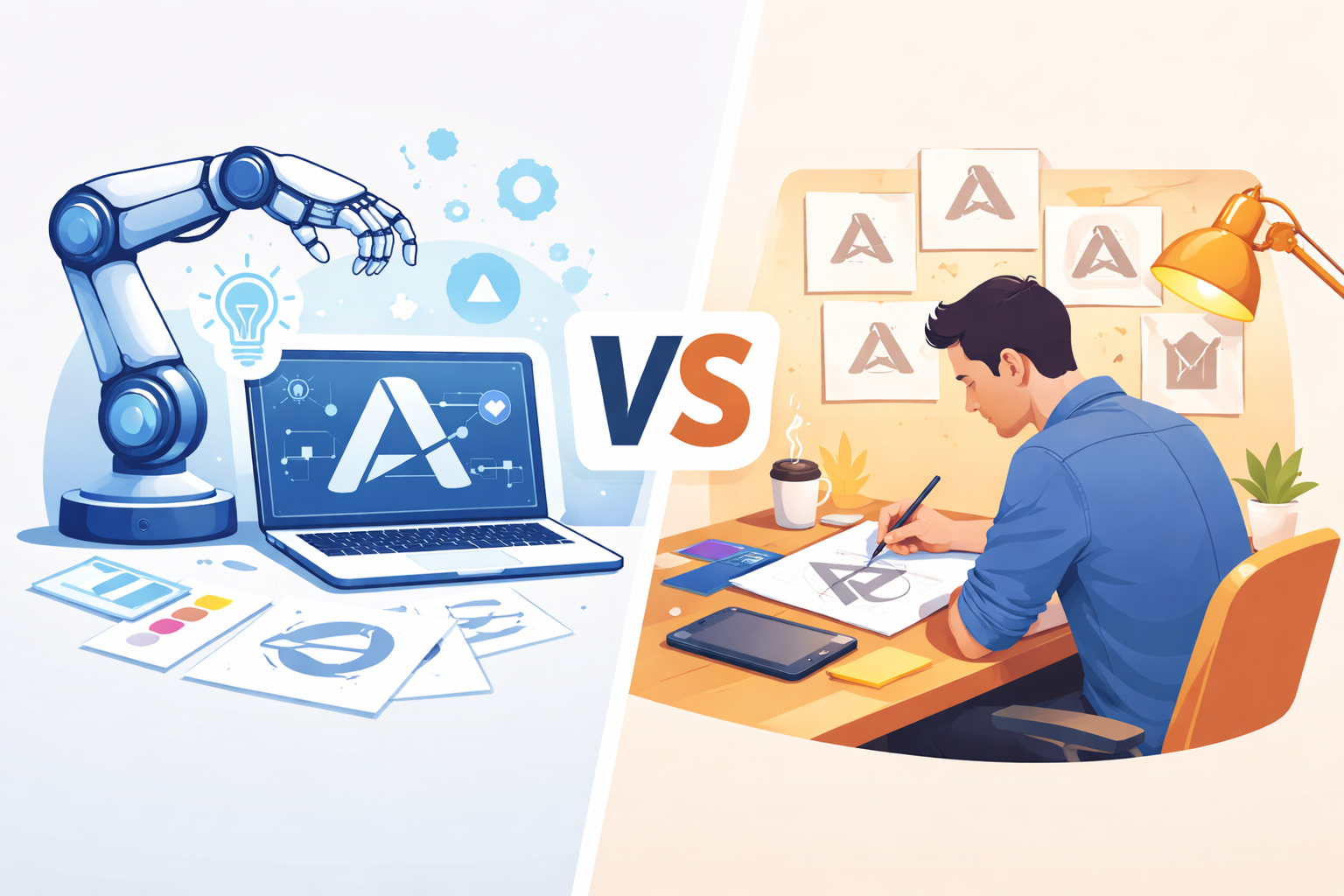
AI logo generators vs human designers visual comparison

AI tools can generate a logo in under 30 seconds. A skilled human designer might spend two to three weeks perfecting one. As AI logo generators become faster and more capable, millions of founders, marketers, and small business owners are asking the same question: should you trust an algorithm to define your brand, or hire a professional designer?

The honest answer is not binary. Both approaches have genuine strengths, real limitations, and specific contexts where they shine. This guide breaks down everything you need to know, with data, side-by-side comparisons, and practical decision frameworks to help you choose the right path for your project.


What Is an AI-Generated Logo?

An AI-generated logo is produced by automated design systems that combine machine learning, icon libraries, template structures, and typographic rules to generate logo variations based on user inputs. You typically enter your business name, select an industry or style preference, and the tool outputs dozens of options within seconds.

Most AI logo generators, such as Looka, Wix Logo Maker, and Canva's logo tool, operate on parametric design systems: pre-built visual grammars that swap colors, fonts, and icons according to rules rather than original thought. The underlying assets, icon sets, typefaces, and layout grids, are shared infrastructure used across thousands of generated logos.

Key characteristics of AI-generated logos include:

  • Template-based structure drawn from shared design assets
  • Rapid generation of multiple variations (often 50+ options in seconds)
  • User-driven customization of color, font, and layout after generation
  • Instant export in common formats like PNG and SVG
  • Minimal brand strategy input beyond category and style preference

If you are curious about how these files are structured and what formats you will receive, our guide on the best logo formats for websites explains SVG, PNG, and JPG differences in detail.


What Human Designers Actually Do

Professional logo design is a research-driven, iterative process that goes far beyond making something that looks good. A skilled brand designer functions as a visual strategist, translating business goals, audience psychology, and market positioning into a single, memorable mark.

A typical professional logo design engagement might look like this:

The Professional Design Process

1
Discovery & Brief
Brand values, audience, competitors, tone of voice, and long-term vision are documented and discussed.
2
Market & Competitor Research
Visual landscape analysis to identify white space and differentiation opportunities.
3
Concept Sketching
Hand-drawn or digital ideation across multiple directions, each rooted in strategic reasoning.
4
Refinement & Feedback
Multiple revision rounds with the client, testing logo across real-world applications.
5
Brand System Delivery
Final files delivered with color system, typography, usage guidelines, and multiple format variations.

This process typically takes two to six weeks and results in something an AI cannot produce: a logo with a strategic rationale, one that communicates specific things to specific people and scales across every context, from a favicon to a billboard.

Professionals also consider long-term scalability. For example, they think about how a logo will work in monochrome, across both colored and white backgrounds, and whether the mark will hold up at tiny sizes or in embroidered form.


The Data: How Big Is the AI Logo Market?

AI logo generation is not a niche phenomenon. The numbers behind it reveal how dramatically the design industry is shifting.

$4.8B Projected global AI design tools market by 2028 Source: MarketsandMarkets, 2024
30s Average time for AI to generate a complete logo set vs. 2-6 weeks for professional design
$0–$80 Typical cost range for AI-generated logo download vs. $500–$5,000+ for professional design
75% Of consumers judge a brand's credibility by its visual identity Source: Stanford Web Credibility Research

The affordability gap is real, but so is the stakes gap. A logo is not just a graphic. It is the first visual impression your business makes, and research consistently shows that visual identity directly influences perceived credibility and purchase intent.


Pros and Cons of AI Logo Generators

Advantages

Speed is unmatched. No other approach comes close to the instant iteration AI tools offer. Within minutes, you can explore dozens of visual directions, color palettes, and typographic combinations. For a founder who needs to validate a brand concept before committing resources, this is enormously valuable.

Cost is dramatically lower. AI-generated logos typically cost between $0 and $80 for downloadable files. Some premium plans extend this to $100 to $200 for full brand kits. Compare that to the $500 to $5,000 minimum most professional designers charge, and the accessibility advantage is obvious.

No design skills required. AI tools make logo creation accessible to people who have never opened a design application. The interface is conversational: enter a name, pick a style, and you have something to work with.

Rapid iteration for testing. If you want to A/B test two brand directions with real users before investing in professional design, AI tools let you mock up those concepts cheaply and quickly.

Limitations

Template similarity is a structural problem. Because AI logo generators draw from shared icon libraries and design templates, the same icons, layouts, and font pairings appear across thousands of different companies' logos. Your tech startup might end up with the same geometric mark as a dozen other businesses in your category.

AI has no understanding of your brand. A logo generator does not know what your company believes, who your ideal customer is, or what makes you different from competitors. It optimizes for aesthetically acceptable, not strategically correct.

Weak differentiation in competitive markets. In markets where brand trust matters, such as professional services, healthcare, or luxury goods, a template-derived logo can signal that the business is not serious about its identity. This is not a trivial risk.

Limited file flexibility. Many AI tools export only PNG or low-resolution formats in their base tiers. For print-ready applications, you need vector files. Our guide on vector vs raster logos explains why this matters, and if you need to work with print production, see our print-ready logo setup guide.

Key insight: AI tools optimize for speed and visual acceptability. Human designers optimize for distinctiveness and strategic fit. These are fundamentally different goals, and the right choice depends entirely on which one your project actually needs.


Pros and Cons of Hiring a Human Designer

Advantages

Strategic thinking. A professional designer aligns your visual identity with your business goals. They ask questions like: Who are you trying to attract? What do you want people to feel when they see this mark? How does this logo position you against competitors? AI does not ask these questions.

Original, custom concepts. Human designers can create custom letterforms, original illustrations, and conceptually rich symbols that are genuinely unique. When you think about iconic logos like FedEx's hidden arrow or Amazon's A-to-Z smile, these are not accidents. They are the products of deliberate creative thinking.

Iterative refinement. Professional engagements include feedback cycles. The designer is not just generating options; they are refining a concept based on your input until it is right. This back-and-forth is part of the value.

Complete brand systems. A professional logo engagement usually delivers far more than a mark. You receive color palettes, typography guidance, spacing rules, and usage guidelines that allow your whole team to apply the brand consistently. Knowing how to work with logo placement and format variations is part of this deliverable.

Full vector file delivery. Professional designers deliver production-ready files including EPS, AI, and SVG formats. If you want to understand what you are receiving, our article on EPS logo files breaks it down.

Limitations

Cost can be prohibitive for early-stage businesses. A quality freelance designer charges $500 to $2,500 for a logo project. Agencies start higher. For a pre-revenue startup, this investment may not be feasible before product-market fit is established.

Time to delivery is longer. Even a fast designer takes days. A thorough brand identity project takes weeks. If you need something today, a human designer cannot match AI speed.

Quality varies widely. The professional design market is not uniform. Hiring a $150 freelancer from a gig marketplace is not the same as hiring a $3,000 senior brand designer. The label "professional designer" covers a vast range of skill levels.


When Should You Use AI vs. a Human Designer?

Rather than declaring one approach universally superior, it is more useful to match the tool to the context.

Use AI When...

  • You are testing a business idea before committing
  • Building an MVP and need a placeholder identity
  • Running a short-term campaign or pop-up project
  • Exploring visual directions before a designer brief
  • Operating a personal or hobby project
  • Budget is genuinely zero or near-zero
  • Speed is the primary constraint

Hire a Human When...

  • Building a brand intended to last 5+ years
  • Launching a funded startup or growth-stage company
  • Operating in a trust-sensitive category
  • Your brand will appear on physical products
  • You need a complete brand identity system
  • Differentiation from competitors is critical
  • You are rebranding an existing business

The decision often comes down to stage of business and brand ambition. A first-week side project does not need the same visual investment as a Series A startup preparing to market nationally.

Many successful companies have followed a two-phase approach: start with AI or a simple wordmark to get moving, validate the business, then invest in professional identity design once you have revenue and a clearer brand story. This is a legitimate strategy, not a compromise.

If you are thinking about what type of logo structure makes sense before engaging a designer, our comparison of wordmark vs symbol logos can help you think through the fundamentals.


Quality Differences: What You Actually Notice

Beyond strategy and process, there are specific, observable quality differences between AI-generated and professionally designed logos that matter in practice.

Scalability

Professional designers think about how a logo performs across every possible application: embroidered on a jacket, reversed out of a dark background, displayed at 16px as a favicon, printed two feet wide on a trade show banner. AI tools generate a logo that looks good in the interface preview. These are very different standards.

Understanding logo resolution and DPI is essential if you plan to use your logo across print and web applications. A professional designer will ensure this is handled correctly from the start.

Originality

AI-generated logos use shared icon databases. The mountain icon you selected may be used by hundreds of other outdoor brands. Professional designers can create marks that are genuinely original, sometimes through custom lettering, bespoke illustration, or conceptually layered symbols that no one else has.

This connects directly to legal risk. A logo built from widely-distributed template assets has greater exposure to design conflicts. A custom-designed mark is more defensible as intellectual property.

Typography

AI tools select from available font libraries and apply them directly. Human designers understand typographic nuance: letter spacing, optical alignment, custom modifications to letterforms, and pairing logic that makes a wordmark feel cohesive with its symbol. If you are interested in how these details work, our guide to minimalist logo design shows how much craft goes into apparently simple marks.

File Formats and Deliverables

When you hire a professional designer, you should receive a complete file package including vector source files (AI or EPS), SVG for web, PNG on transparent backgrounds in multiple sizes, and often a brand guidelines document. AI tools frequently lock higher-quality files behind premium tiers, and the source files may not be editable in the same way.

If you end up with files in the wrong format, our guide on how to convert logo files can help you navigate that situation.


The Hybrid Approach: AI as a Designer's Tool

A framing that is increasingly relevant: AI and human designers are not always competitors. Many professional designers now use AI tools as part of their creative workflow.

AI can rapidly generate mood board variations, explore visual directions, and produce rough concept options that a designer then refines, elevates, and builds into something genuinely original. In this model, AI accelerates early-stage ideation while human judgment governs the final direction.

Some designers are also using AI specifically for logo prompt engineering, developing structured prompts that generate more useful starting points for creative development. This is a workflow skill in itself, not a replacement for design thinking.

The hybrid model produces better results than pure AI generation while being faster than traditional process alone. It is where much of professional design is heading.

The real question is not AI vs. human. It is who is making the strategic decisions? If an AI is making those decisions unsupervised, you are at risk. If a human designer is using AI to accelerate execution while driving the strategy, you are likely getting excellent value.


Brand Perception and the Business Case for Quality

There is a practical business argument for professional design that goes beyond aesthetics. Brand perception directly affects customer behavior, and logo quality is a significant part of brand perception.

According to Stanford's Web Credibility Research, visual design is the number one factor users cite when assessing whether a website or brand is trustworthy. In professional services, healthcare, finance, and legal industries, a template-derived logo can actively undermine the credibility you are trying to build.

For e-commerce brands, Nielsen research has repeatedly shown that brand recognition (which depends on consistent, distinctive visual identity) significantly increases repeat purchase rates and customer lifetime value.

This does not mean every business needs to spend $5,000 on a logo. It means that as your business grows and your brand becomes a more significant commercial asset, the return on professional design investment increases proportionally.

Consider also the downstream costs of rebranding. A company that launches with an AI-generated logo and then rebrands professionally two years later has to update every touchpoint: website, social profiles, product packaging, business cards, email signatures, presentations, and more. Doing the strategic work early is often more cost-efficient over a 5-year horizon.

For teams working with logos across different tools and contexts, see our guides on using logos in Figma and using logos in PowerPoint for practical application guidance.


AI Logo Quality Is Improving: What to Expect Next

It would be intellectually dishonest to ignore the trajectory. AI logo tools in 2025 are meaningfully better than they were in 2022. Generation quality has improved, customization options have expanded, and some tools now incorporate brand strategy prompts into the generation workflow.

The fundamental limitation, however, is unlikely to change soon: AI optimizes for visual patterns it has learned from existing design, which means it excels at producing work that looks like existing design. Creating a genuinely novel visual identity, one that does not reference existing visual conventions, remains a distinctly human capability.

What will likely evolve is the collaboration model. AI tools will become better at capturing brand intent, at asking smarter questions before generating, and at producing higher-fidelity starting points that human designers can refine. The creative ceiling will still be set by the human in the loop.

For businesses thinking about their full visual asset library, LogoToUse offers professionally prepared logo resources across black and colored variants, ready for real-world application.

AI Logo Generators vs Human Designers: Full Comparison

Factor AI Logo Generators Human Designers
Speed Seconds to minutes Winner Days to weeks
Cost $0 to $200 Winner $500 to $5,000+
Uniqueness Limited (shared assets) High (custom concepts) Winner
Brand Strategy Minimal Brand-focused Winner
Scalability Basic Full system design Winner
File Quality PNG / basic SVG Full vector + guidelines Winner
Iteration Instant regeneration Winner Structured feedback rounds
Originality Template-derived Fully original Winner
Legal Safety Moderate risk Higher defensibility Winner
Beginner Accessibility No skills needed Winner Requires briefing skills
Long-term Brand Value Limited High Winner

Frequently Asked Questions

Are AI-generated logos unique?

Not typically. Most AI logo generators draw from shared icon libraries and template systems. This means the same icon, layout pattern, or font pairing can appear across thousands of different companies' logos. The result is not unique in any meaningful sense. If originality is important to your brand, this is a significant limitation of AI-generated logos compared to custom professional design.

Can AI replace logo designers?

Not fully, and not yet. AI can automate visual pattern generation, which handles a portion of what designers do. But it cannot replicate strategic thinking, audience understanding, competitive analysis, or the conceptual creativity that makes a logo genuinely distinctive. What AI is doing is automating the lower end of the design market, where speed and cost were the primary differentiators. Skilled brand designers who work at the strategic level are not being replaced; their work is being augmented.

Are AI logo generators free?

Most AI logo tools offer free generation and previewing, but charge for downloadable files in high-resolution or vector formats. Typical pricing ranges from $20 to $80 for a basic logo download, with higher tiers for brand kits that include multiple file formats, color variations, and brand usage guidelines. Always confirm what formats are included before purchasing, since vector formats are essential for print use.

Do professional logos perform better for branding?

Yes, in most contexts. Custom-designed logos tend to perform better for brand recognition and credibility because they are tailored to a specific business, market position, and audience. The visual differentiation that results from strategic design creates stronger memory encoding in consumers. Template-based logos, by contrast, can create visual confusion when similar marks appear across different brands in the same category. The effect is most pronounced in trust-sensitive industries like finance, healthcare, and professional services.

Can I edit an AI-generated logo later?

It depends on the tool and file format. Most AI generators allow in-platform editing of colors, fonts, and layouts. If you download SVG files, you can edit these in tools like Figma, Illustrator, or Inkscape. PNG files are raster-based and cannot be edited at the vector level. Our guide on converting logo file formats covers your options if you need to work with different formats after downloading.

Should startups use AI logos?

It depends on stage. Pre-product, pre-revenue startups that are still validating their idea can reasonably use an AI-generated logo as a placeholder. It lets you move quickly without over-investing in brand identity before the business model is proven. Once you have product-market fit, paying customers, and a clearer sense of who you are and who you serve, investing in professional brand design becomes much more valuable. Many successful companies have followed this exact path.

What file formats should I expect from a professional logo designer?

A professional logo delivery should include vector source files (AI or EPS for full editability), SVG for web use, PNG with transparent background in multiple sizes, and often a brand guidelines PDF. Some designers also deliver JPEG versions for specific use cases. Our guide on EPS logo files explains the vector format standard, and our logo formats guide covers the full range of options and when to use each.

How much does a professional logo design cost in 2025?

Costs vary widely based on designer experience and scope. Freelance designers on platforms like Contra or LinkedIn typically charge $500 to $2,500 for a logo project. Mid-tier brand design studios range from $2,500 to $10,000. Premium brand agencies working with larger companies charge $15,000 and upward. The wide range reflects the equally wide range in strategic depth, deliverables, and designer experience. As a general rule, if a professional logo quote seems implausibly cheap, the deliverable will reflect that.

Read more

Subscribe to get fresh stories, tips, and logo resources delivered straight to your inbox.