Brand Logos
|
Mar 11, 2026
Famous Fashion Brand Logos
This guide covers the most iconic fashion brand logos, what makes them work, and how designers can use them effectively in professional projects. Whether you're researching luxury identity design, building mood boards, or looking for clean logo assets, this is your starting point.
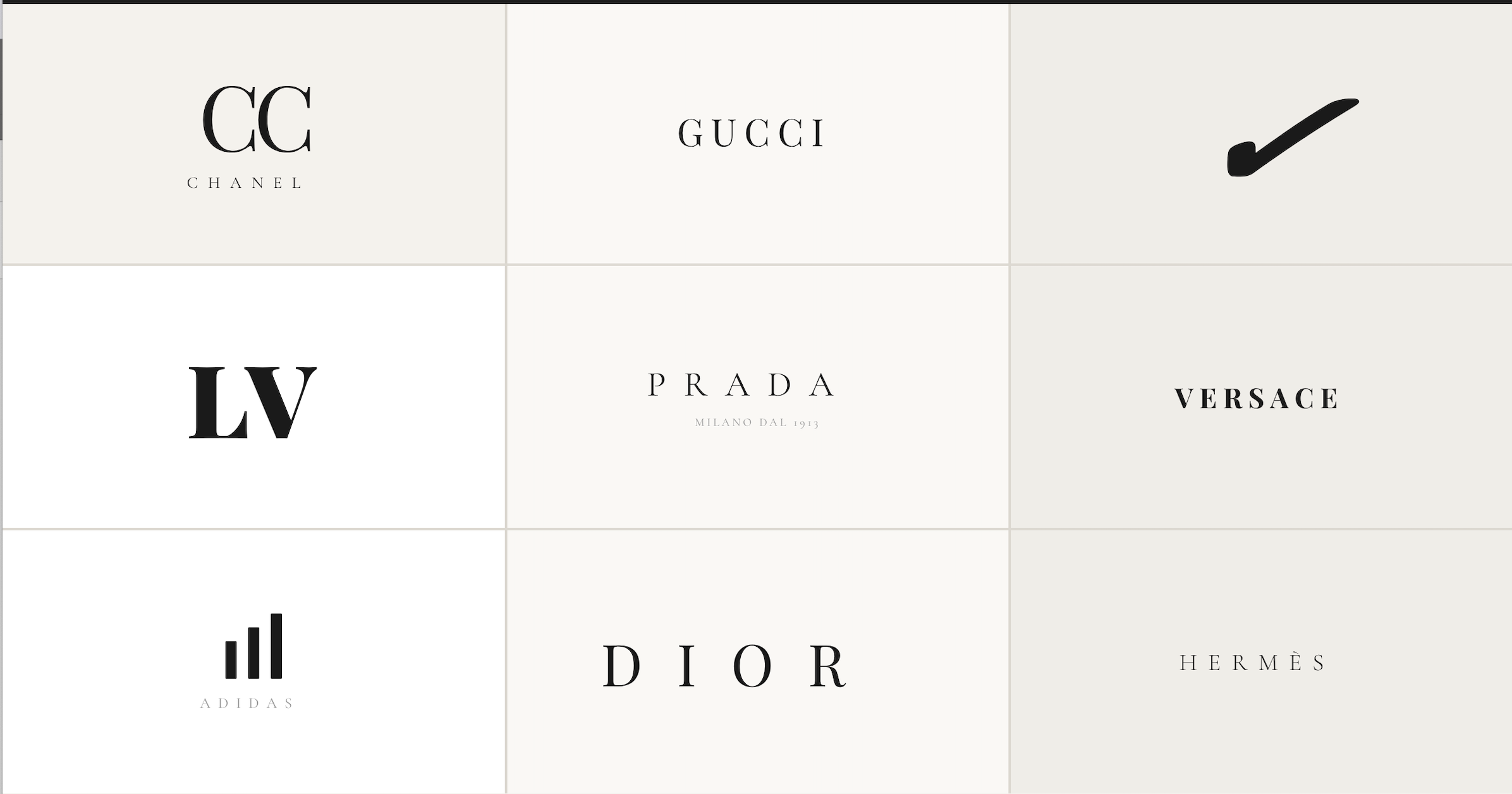
Fashion brands live and die by their logos. In an industry built on perception, status, and aesthetic, a logo is never just a logo. It is a promise, a price tag, and a piece of cultural history compressed into a single mark. Some of the most recognized symbols on earth belong not to tech giants or banks, but to fashion houses. The Chanel double C. The Nike Swoosh. The Louis Vuitton monogram. These marks have transcended branding to become part of the global visual language.
This guide covers the most iconic fashion brand logos, what makes them work, and how designers can use them effectively in professional projects. Whether you're researching luxury identity design, building mood boards using some of the best photography sites for inspiration, or looking for clean logo assets, this is your starting point.
What Makes a Fashion Logo Memorable
Not every logo becomes iconic. In fashion, the ones that last tend to share a handful of core design traits. Understanding those traits is the first step to understanding why certain marks endure for a century while others fade within a decade.
Minimalism as a Signal of Luxury
There is a well-documented relationship between visual simplicity and perceived prestige. Luxury fashion brands have long embraced restraint in their logos. No gradients. No drop shadows. No decorative flourishes. Just clean letterforms or a simple symbol on a white or black background.
This minimalism is intentional. When a brand like Bottega Veneta strips its logo to plain lowercase type, it signals confidence. It says the name alone is enough. According to a study cited by the Journal of Consumer Psychology, consumers associate visual simplicity with exclusivity and higher price perception. The fewer the visual elements, the more premium the product feels.
Brands like Celine, Balenciaga, and Saint Laurent have all undergone logo redesigns in the 2010s specifically to strip out unnecessary complexity, moving toward clean sans-serif wordmarks. The redesigns were controversial but strategically sound.
Typography as Identity
Most fashion logos are, at their core, typography exercises. The font choice carries enormous weight. Serif typefaces communicate heritage and tradition. Sans-serifs communicate modernity and precision. The distinction explains why Dior and Chanel use refined serif-adjacent lettering while Calvin Klein and Zara lean into clean sans-serif wordmarks.
Custom lettering takes this further. Many top fashion houses use proprietary typefaces or hand-drawn letterforms that cannot be replicated. This makes the logo both unique and defensible as intellectual property. For a deeper look at how wordmark-driven logos work versus symbol-based ones, the wordmark vs symbol logo breakdown is essential reading.
Monograms: The Shorthand of Status
Monogram logos are a fashion staple precisely because they solve an elegant problem: how do you make a long name instantly wearable? Louis Vuitton (LV), Gucci (double G), Chanel (double C), and Versace (V-anchor mark) all use monograms that function both as logos and as repeatable surface patterns.
The genius of the monogram system is that it creates a logo that scales. It works as a small embossed detail on a leather good, as a full repeat pattern on a canvas bag, and as a large embroidered element on clothing. One mark, infinite applications.
Black and White Dominance
Walk into any luxury department store and look at the shopping bags. The overwhelming majority will be black and white. This is not coincidence. Black and white logos communicate timelessness, legibility, and universality. They work on any background, in any context, at any size.
Brands like Chanel, Prada, and Saint Laurent have built entire visual identities around monochromatic discipline. The constraint forces every design decision to rely on form and proportion rather than color. If a logo only works in color, it is not a strong logo. The principles behind monochrome logo design explain why this approach has become the gold standard in luxury.
Heritage Storytelling Through Symbols
Some fashion logos carry centuries of narrative. Burberry's equestrian knight dates to 1901. Versace's Medusa head draws from Greek mythology. Hermès has anchored its identity to a horse-drawn carriage since the 1950s, a direct reference to the brand's origins as a harness maker.
These symbols serve as brand archaeology. Every time a consumer sees the logo, they are accessing a compressed version of brand history. The logo becomes shorthand for decades or centuries of craftsmanship, heritage, and cultural weight. That kind of storytelling cannot be bought with a rebrand. It has to be earned over time.
Most Recognizable Fashion Brand Logos
These are the marks that need no introduction in any language, on any continent. Each has earned its place in the global visual canon through consistency, quality, and cultural saturation.
Nike
The Nike Swoosh is arguably the most recognizable logo in human history. Designed by Carolyn Davidson in 1971 for a fee of $35, it represents motion, speed, and aspiration. Nike acquired the full rights to the mark later and rewarded Davidson with company stock as the brand grew into a global giant. Today, Nike's brand value exceeds $30 billion according to annual brand valuation reports. The Swoosh works because it is simple, directional, and infinitely scalable. It communicates energy without a single word.
Adidas
The Adidas three-stripe logo is another masterclass in minimalism. Originally a functional detail on athletic shoes (the stripes reinforced the upper), it evolved into one of the most copied marks in counterfeit goods, which is itself a testament to its recognition value. Adidas has maintained multiple logo variants including the trefoil and the mountain mark, each used across different product lines, but the three stripes remain the unifying thread across everything the brand produces.
Chanel
The interlocked double C designed by Gabrielle "Coco" Chanel in 1925 is one of the defining symbols of 20th century fashion. Its symmetry and simplicity made it immediately reproducible as a monogram pattern, and it has appeared on everything from handbag quilting to fine jewelry. The logo has not changed meaningfully in 100 years, which is itself a statement about permanence in a trend-driven industry.
Gucci
The double G monogram introduced under Guccio Gucci's direction became the defining mark of Italian luxury in the post-war era. Under creative director Alessandro Michele and later Sabato De Sarno, the brand has continued to evolve its aesthetic while keeping the interlocked G as its core symbol. The Gucci monogram is among the most counterfeited marks globally, with the fashion industry losing an estimated $50 billion annually to counterfeit goods according to research from the International Chamber of Commerce.
Louis Vuitton
The LV monogram, introduced in 1896 by Georges Vuitton, was designed specifically to combat counterfeiting of the brand's trunk designs. The irony is that it has since become one of the most counterfeited patterns in history. The monogram pattern, combining the LV initials with flowers and geometric shapes, is applied across the brand's leather goods, apparel, and accessories in a seamless repeat that has remained virtually unchanged for over 125 years.
Prada
Prada's logo is a study in aristocratic restraint. The wordmark in its custom serif font, paired with the triangular enamel badge first introduced in the 1910s, communicates old-money elegance. The triangle badge carries the words "Prada Milano Dal 1913," anchoring the brand in its Italian heritage and founding date. Simplicity backed by history.
Versace
The Medusa head is one of fashion's most dramatic logos. Gianni Versace chose the Greek mythological figure deliberately: Medusa made people fall in love with her and they had no way back. The logo communicates opulence, mythology, and confrontation. It is the opposite of quiet luxury, which is precisely the point.
Balenciaga
Balenciaga's wordmark has become a reference point in the ongoing conversation about luxury fashion's typographic shift toward extreme minimalism. The current sans-serif iteration, stark and unadorned, has divided opinion but achieved exactly what it intended: it forces attention to the word itself rather than any decorative framework. In a sea of heritage-coded serifs, it stands apart.
Hermès
The Hermès horse-and-carriage logo (Le Duc) is a direct lineage marker. Founded in 1837 as a harness and bridle workshop, Hermès encoded its origin story directly into its primary logo. The mark communicates craftsmanship, provenance, and a specific kind of understated French luxury that is distinct from Italian maximalism.
Burberry
The Burberry equestrian knight, paired with the Latin motto "Prorsum" (meaning "forward"), was designed in 1901. The brand's iconic check pattern, introduced in the 1920s as a lining for its trench coats, became a standalone pattern logo in the 1990s and was later scaled back after becoming overexposed through widespread counterfeiting. The lesson: even great logos can be diluted by overuse.
Supreme
Supreme's box logo, a direct appropriation of graphic designer Barbara Kruger's distinctive red-box-with-white-text visual style, is a case study in how streetwear brands build identity. The logo's value lies entirely in scarcity and cultural positioning. It is not technically sophisticated, but it has become one of the most valuable marks in streetwear, with Supreme eventually selling to VF Corporation for $2.1 billion in 2020.
Dior
Christian Dior founded his house in 1946 with a clear aesthetic vision: femininity, elegance, and post-war luxury. The Dior wordmark, with its specific serif letterforms, has remained remarkably consistent since the brand's founding. The CD monogram serves as the secondary mark, appearing on hardware and accessories. Together they communicate heritage without nostalgia.
Luxury Fashion Brand Logos: Design Patterns That Define High-End Identity
Luxury fashion logos share a set of design decisions that distinguish them from mass-market marks. Understanding these patterns helps designers work more effectively with these assets and helps brands make more intentional decisions.
Serif typography dominates the luxury tier. Serif typefaces carry centuries of association with print craftsmanship, authority, and permanence. Brands like Dior, Prada, Hermès, and Chanel all use serifs or serif-adjacent letterforms that reference the tradition of fine typography.
Monograms function as a luxury shorthand. When a brand reaches the point where two letters represent an entire lifestyle, the monogram is complete. LV, CC, GG, and CD are all examples of initials that have been elevated to symbols through decades of consistent application and cultural reinforcement.
Heritage symbolism uses visual references to anchor a brand in time. The horse at Hermès, the knight at Burberry, the Medusa at Versace: each symbol is a deliberate connection to an origin story, a mythology, or a historical moment that gives the brand narrative depth beyond its products.
Color restraint is perhaps the most consistent signal. Black text on white backgrounds, white text on black backgrounds, occasional use of the house color (Tiffany blue, Hermès orange, Valentino red): luxury logos use color as a punctuation mark, not a primary vehicle.
For anyone working with luxury brand assets, understanding vector vs raster logo formats is foundational. Luxury brand assets must be reproduced across a staggering range of scales, from embossed hardware to building-sized billboards, and vector formats are the only way to ensure clean reproduction at every size.
Sportswear Fashion Logos
The boundary between sportswear and fashion has collapsed almost entirely. What was once purely functional athletic apparel is now one of the dominant aesthetic forces in global fashion. And the logos that drive it are some of the most powerful marks on earth.
Nike
The Swoosh operates equally in sport, streetwear, and high fashion. Nike's collaborations with designers like Virgil Abloh, Sacai, and Jacquemus have elevated the Swoosh into luxury contexts without diluting its athletic roots. This cross-category fluidity is rare and valuable.
Adidas
Adidas has maintained dual brand identities with unusual success. The performance-oriented three-stripe mark and the more fashion-forward Trefoil (used by Adidas Originals) serve different audiences without creating brand confusion. The three-stripe logo also holds a unique legal distinction: Adidas has won multiple court cases defending its exclusive right to the three-stripe mark in apparel.
Puma
The Puma leaping cat mark is one of the few sporting logos that uses an actual animal illustration rather than an abstract symbol. Founded by Rudolf Dassler (brother of Adidas founder Adi Dassler), Puma has positioned itself more aggressively in the fashion space in recent years through collaborations with Rihanna's Fenty brand and AMiri.
Under Armour
The UA interlocking monogram is relatively young by brand standards, founded in 1996, but has built strong recognition particularly in American performance sports markets. The mark is built on overlapping U and A letterforms creating a shield-like silhouette, a deliberate signal of protection and performance.
New Balance
New Balance's "N" mark is an interesting case study in brand revival through cultural adoption. Long associated with dad shoes and running clubs, New Balance was adopted by the fashion community in the late 2010s and has since become a streetwear staple. The logo itself barely changed; the cultural context around it transformed entirely.
Logo Design Breakdown
Luxury Fashion vs. Sportswear Brand Logos
100+
Years avg. luxury logo lifespan
$30B
Nike brand value (Statista)
$509B
Global counterfeit goods market
1925
Year Chanel CC logo created
Luxury Fashion
Heritage & Restraint
Chanel, Dior, Hermès, Prada, LV
Serif or Custom Typography
Communicates tradition, authority, and permanence. Often proprietary letterforms.
Monochromatic Color System
Black and white dominate. Color used sparingly as a single brand accent.
Monogram as Pattern
Two initials become a repeatable surface system. Scales from hardware to billboards.
Decades of Stability
Redesigns rare and strategic. Logo longevity is part of the brand promise.
Heritage Symbolism
Origin stories encoded visually. The logo carries historical meaning.
VS
Sportswear
Motion & Universality
Nike, Adidas, Puma, New Balance
Abstract Symbols
Not tied to any sport, language, or market. Works across every global context.
Energy and Movement
Marks suggest forward motion, speed, and aspiration. Dynamic rather than static.
High Contrast Simplicity
Works on athletic gear, screens, stadiums. Built for legibility at every scale.
Cross-Category Flexibility
Same mark works in performance, streetwear, and high-fashion collaborations.
Collaboration-Ready
Sportswear logos frequently co-brand with luxury houses without visual conflict.
Selected Brand Examples
CHANEL
Est. 1910
DIOR
Est. 1946
HERMÈS
Est. 1837
NIKE
Est. 1964
ADIDAS
Est. 1949
PUMA
Est. 1948
Minimalist Fashion Logos
The shift toward extreme minimalism in fashion logos is one of the defining design trends of the past decade. Brands across price points have stripped back their visual identities in favor of clean, typography-only marks.
Calvin Klein has been typographic since its founding. The clean, geometric sans-serif wordmark designed in the 1970s predates the current minimalism trend by decades. It has barely changed and remains one of the most recognizable wordmarks in fashion.
Balenciaga completed a controversial typographic overhaul in 2017 under Demna Gvasalia, replacing a more traditional logo with an extreme sans-serif wordmark. The reaction was divided, but the new mark aligned perfectly with the brand's post-fashion, anti-glamour aesthetic.
Zara operates at fast fashion scale but maintains a luxury-adjacent visual identity. The tightly tracked serif wordmark (redesigned in 2019 by Baron & Baron) is deceptively sophisticated for a mass-market brand. The tight letter spacing creates tension and elegance that punches above the brand's price point.
COS (Collection of Style), the H&M Group's premium line, uses a simple, clean wordmark that mirrors the brand's product aesthetic: understated, architectural, Scandinavian. There is no icon, no symbol, just the name in clean type.
Uniqlo presents an interesting bilingual logo challenge, maintaining distinct Japanese (ユニクロ) and Latin alphabet versions of its wordmark. The red-and-white color system creates instant recognition across both scripts.
The deeper logic behind minimalist logos is explored in depth in this guide to minimalist logo design. The short version: removing elements from a logo is much harder than adding them. True minimalism requires confidence in every remaining stroke.
How Designers Use Fashion Logos in Projects
Fashion brand logos are among the most frequently used assets in professional design work. Understanding the right contexts and file formats makes the difference between professional results and amateur-looking work.
Fashion mood boards are probably the most common use case. Stylists, art directors, and brand strategists build mood boards to communicate aesthetic direction, and fashion logos serve as cultural shorthand. A board featuring Hermès, The Row, and Loro Piana tells a very different story than one featuring Supreme, Off-White, and Palace.
Brand comparison and competitive analysis work requires clean, consistent logo assets. Presenting a brand landscape to a client means showing competitor logos at equal size, weight, and quality. Inconsistent logo quality undermines the credibility of the analysis.
UI and ecommerce mockups regularly require fashion brand logos as placeholder or demonstration assets. Product page designs, checkout flows, and app interfaces often use real brand logos to communicate how the final product will look before actual client assets are delivered.
Streetwear and apparel design inspiration draws heavily from the graphic language of fashion logos. The bold typography of Supreme, the clean monogram systems of luxury houses, and the symbol-driven marks of sportswear brands all feed into the visual vocabulary of independent designers.
Educational presentations in design schools, brand strategy programs, and marketing curricula use fashion logos constantly as examples of effective (and occasionally ineffective) visual identity work.
Download Fashion Brand Logos for Design Projects
Working with fashion brand logos in design requires clean, well-formatted assets. The difference between a polished design and an amateur one often comes down to logo quality.
SVG (Scalable Vector Graphics) is the gold standard for screen-based work. Because SVG files are mathematically defined rather than pixel-based, they scale to any size without quality loss. A Chanel logo in SVG will be as crisp on a 4K monitor at 3000px as it is as a 32px favicon. For more on vector file formats, the EPS logo file guide explains how EPS and SVG relate in professional print and screen workflows.
PNG with transparent backgrounds is the workhorse format for most design workflows. Transparent PNGs drop cleanly onto any background color without white boxes or fringing. This is essential for mockup work, presentations, and any context where the logo will be placed on a non-white surface.
Consistent quality across color variants matters more than most designers initially realize. A brand logo typically exists in at least three versions: full color, all-black, and all-white (reversed). Having all three available makes adapting to different background conditions fast and seamless.
Fashion Logos and Their Meaning: A Deeper Look
Every element of a fashion logo carries intention. Color, typography, symbol choice, proportions: none of it is accidental at the brand level.
The Chanel double C is a mirror image of Coco Chanel's initials. The interlocking, reversed second C creates a symmetry that works as both a monogram and an abstract pattern. It is thought that Chanel may have been influenced by the stained glass windows of the Aubazine abbey where she spent part of her childhood, though this origin is the subject of some historical debate.
The Nike Swoosh was designed to suggest movement. Its abstract form has no literal meaning beyond speed and motion, which is precisely what makes it universally applicable. It doesn't anchor Nike to any single sport, geography, or cultural moment.
The Louis Vuitton monogram was specifically designed in 1896 by Georges Vuitton as an anti-counterfeiting measure, combining his father's initials with a Japanese-influenced floral and geometric pattern. The historical irony of it becoming the most counterfeited pattern in fashion history is complete.
The Hermès orange is a logo color story unto itself. The brand's distinctive orange boxes were not an original design choice: during World War II, Hermès' supplier ran out of the cream-colored cardboard it had been using and substituted orange. The brand kept it, and it has since become one of the most recognizable brand colors in luxury retail.
The Versace Medusa was chosen because, according to brand lore, Gianni Versace wanted a symbol that represented both fatal attraction and the merging of two worlds: the human and the mythological. It is a deliberately confrontational logo in a sector that usually favors discretion.
Brand History
A Century of Iconic Fashion Logos
1800s
1900s
1920s–30s
1940s–60s
1970s+
Hermès
Le Duc — Horse & Carriage
Founded as a harness and bridle workshop in Paris. The horse-drawn carriage logo directly encodes its origin as a craftsman of equestrian goods.
Oldest luxury logo still in continuous use
1837
1901
Burberry
Equestrian Knight — "Prorsum"
The armored knight carrying a shield with "Prorsum" (Latin: forward) established Burberry as a heritage British brand with a clear visual identity over 120 years ago.
Latin motto: "Prorsum" — Forward
Louis Vuitton
LV Monogram Pattern
Georges Vuitton introduced the LV monogram in 1896 to combat counterfeiting of his father's trunks. It combined their initials with a Japanese-influenced floral motif — and became the world's most counterfeited pattern.
Designed to prevent copying. Irony ensued.
1896
1925
Chanel
Double C Monogram
Coco Chanel's interlocked reversed initials became one of luxury fashion's most enduring symbols. Nearly 100 years later, it remains unchanged — the definition of logo longevity in an industry of constant reinvention.
Unchanged for nearly 100 years
Christian Dior
Serif Wordmark + CD Monogram
Christian Dior founded his house in 1946 with a singular vision: post-war feminine luxury. The refined serif wordmark communicated exactly that. The CD monogram became the brand's hardware and accessory signature.
Post-war luxury — "The New Look" era
1946
1971
Nike
The Swoosh
Carolyn Davidson designed the Swoosh for $35. It went on to represent a brand valued at over $30 billion. The mark has no literal meaning — just speed, motion, and aspiration, which is precisely why it works in every language and every sport.
Original design fee: $35
Versace
Medusa Head
Gianni Versace chose the Greek Medusa deliberately — a figure of fatal attraction and mythology. It was a statement that luxury could be confrontational, maximalist, and mythological rather than quiet and understated.
Based on Greek mythology — fatal attraction
1978
142
Years between oldest and newest logo above
~0
Significant changes to Chanel logo since 1925
$35
Original design fee for the Nike Swoosh (1971)
The Economics Behind Fashion Brand Logos
Fashion logo design is not just an aesthetic exercise. It is a commercial one with measurable financial stakes.
Brand valuation research consistently shows that visual identity consistency is correlated with brand value. According to Interbrand's annual brand valuation, luxury fashion brands maintain some of the highest brand value-to-revenue ratios of any category. Louis Vuitton alone has been valued at over $100 billion in brand equity, a figure that exists almost entirely in perception and cultural positioning rather than physical assets.
The cost to design a major fashion logo ranges from tens of thousands to hundreds of thousands of dollars when done at the level of a global rebranding exercise. Celine's 2018 rebrand, which simply removed the accent from the brand name and adjusted the typeface, was widely discussed in the design press not because of its complexity but because of the strategic precision behind an apparently minor change.
Counterfeit economics also speak to logo value. The OECD estimates that trade in counterfeit and pirated goods reached $509 billion in 2019, with fashion accessories representing a significant share. The fact that logos are being replicated at this scale is, perversely, a measure of their effectiveness. You don't counterfeit marks that nobody wants to wear.
FAQ: Fashion Brand Logos
What is the most recognizable fashion logo?
The Nike Swoosh is generally considered the most recognizable fashion logo globally, followed by the Chanel double C, the Louis Vuitton monogram, and the Adidas three stripes. Recognition varies by region: Louis Vuitton ranks higher in Asian markets, while Nike dominates in North American and European youth demographics.
Why do luxury brands use simple logos?
Luxury brands use simple logos because visual minimalism signals confidence and exclusivity. A complex logo suggests the brand needs decoration to make an impression. A simple, refined mark communicates that the name itself carries sufficient weight. Research in consumer psychology supports the link between visual simplicity and perceived premium positioning.
What fashion brand uses a double C logo?
Chanel uses the interlocked double C logo, designed by founder Gabrielle "Coco" Chanel in 1925. The two reversed, interlocking Cs represent her initials and have become one of the most recognized symbols in luxury fashion.
Which fashion brands use monogram logos?
Several major fashion houses use monogram logos as primary or secondary marks: Louis Vuitton (LV), Gucci (double G), Chanel (double C), Dior (CD), Versace (Gianni Versace used an interlocked GV), and Fendi (double F). Monograms allow brands to create repeatable surface patterns from their logos, extending the mark's applications across products and packaging.
What file format is best for fashion logos in design projects?
SVG is best for screen-based and digital design work where scalability matters. PNG with a transparent background is best for mockups, presentations, and composite layouts. EPS is the standard for professional print workflows. JPG should generally be avoided for logos because it doesn't support transparency and introduces compression artifacts. For a full breakdown, the best logo formats guide covers all major use cases.
Can fashion logos be used in design mockups?
Fashion logos can be used in design mockups for presentation, educational, and portfolio purposes, provided the use is clearly illustrative and non-commercial. Using brand logos in mockups to demonstrate UI design, ecommerce layouts, or presentation templates is standard practice in the design industry. Commercial use, reproduction, or implication of brand endorsement without permission is a different matter and subject to trademark law.
Why do some luxury brands use black and white logos exclusively?
Black and white logos communicate timelessness and universality. They work across any surface, any medium, and any background without requiring color-matching decisions. Many luxury brands (Chanel, Prada, Saint Laurent) rely almost entirely on monochromatic logos because the constraint focuses all attention on form and proportion, the true measures of design quality. The monochrome logos guide goes deeper on the strategic logic.
What is a fashion brand logo?
A fashion brand logo is a visual identity mark used by clothing, accessories, or luxury brands to represent their aesthetic, heritage, and market positioning. Fashion logos typically take the form of wordmarks, monograms, or symbol marks and are applied consistently across products, packaging, advertising, and retail environments to build brand recognition over time.
How often do fashion brands redesign their logos?
Major fashion brands redesign their logos infrequently, often going decades between significant changes. Luxury houses in particular treat logo stability as part of their value proposition. When redesigns do occur (Celine in 2018, Burberry in 2018, Balmain in 2019), they tend to generate significant industry discussion precisely because they are so rare. Fast fashion brands redesign more frequently in response to market shifts.
Which fashion logos are most used in streetwear design?
Supreme's box logo, the Nike Swoosh, the Adidas three stripes, and the Stussy script are the most referenced marks in streetwear design. Palace's triangular Tri-Ferg logo and Off-White's industrial belt and quotation mark motifs also carry significant cultural weight in contemporary streetwear.
Conclusion
Fashion brand logos are some of the most studied, debated, and replicated visual marks in design history. They are not just identity systems; they are cultural artifacts that carry decades of meaning, billions in brand value, and genuine emotional resonance for the people who wear and collect them.
The principles they demonstrate, minimalism as confidence, typography as identity, monograms as scalable systems, heritage as competitive advantage, apply well beyond fashion. Any designer working with brand identity has something to learn from the visual choices made by the houses that have sustained their marks across generations.
Read more
Subscribe to get fresh stories, tips, and logo resources delivered straight to your inbox.