Logo Use Cases
|
Mar 2, 2026
Monochrome Logos Use Cases in Modern Branding
Monochrome logos are one of the most practical and enduring tools in visual identity design. Stripped of color, they force a logo to communicate through form, proportion, and contrast alone — and when that works, it works everywhere.
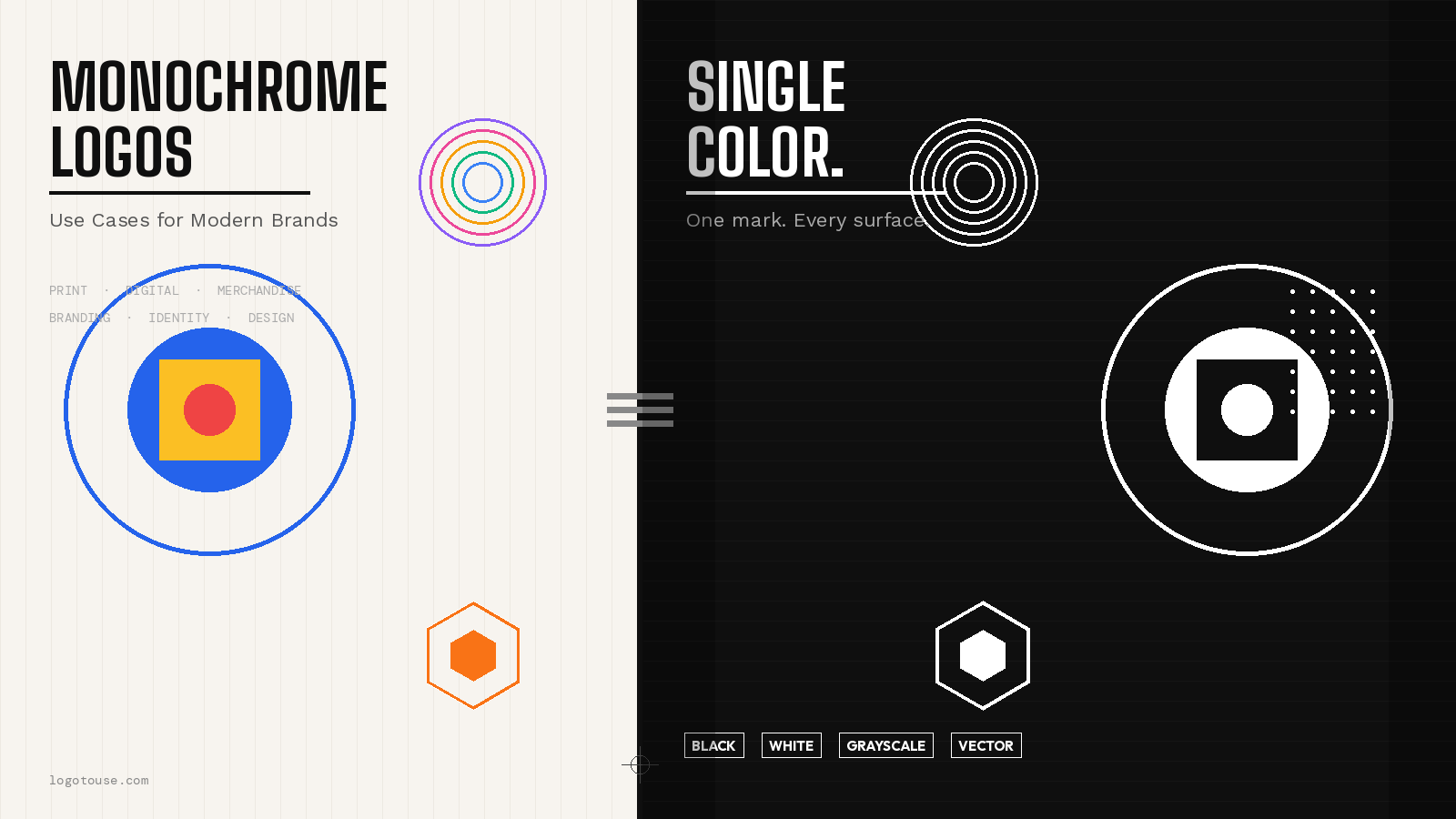
Monochrome logos are one of the most practical and enduring tools in visual identity design. Stripped of color, they force a logo to communicate through form, proportion, and contrast alone — and when that works, it works everywhere.
From embossed packaging to dark-mode app interfaces, a well-designed monochrome logo scales without friction. It prints cheaply, reads clearly at any size, and holds its authority across every medium your brand will ever touch.
This guide breaks down the specific use cases where monochrome logos outperform their colorful counterparts, which industries lean on them most, and how to design one that actually works. Whether you're building a brand from scratch or rationalizing an existing identity system, understanding when and why to go monochrome is a fundamental design skill.
What Is a Monochrome Logo?
Definition
A monochrome logo is a logo rendered in a single color or in varying shades of a single color. This includes fully black, fully white, and grayscale versions, as well as single-color variants in any hue.
The word "monochrome" comes from the Greek monos (single) and chroma (color). In branding, it refers to any mark that uses one consistent color tone across all its elements, with contrast created through shade, opacity, or reversal rather than multiple hues.
Designers and brand managers often use these three terms interchangeably, but they are technically distinct:
- Monochrome logo: Any logo using one color, which may include tints and shades of that color. A navy blue logo with lighter and darker blue tones is monochrome.
- Black and white logo: A logo using only pure black (#000000) and pure white (#FFFFFF), with no intermediate values. LogoToUse maintains separate black and white logo download collections for both variants.
- Grayscale logo: A logo rendered using the full spectrum from black to white, including all gray tones in between. Technically a subtype of monochrome.
For practical branding purposes, the most commonly requested monochrome formats are a pure black version, a pure white version, and a single-color version matching the brand's primary hue. All three serve different surfaces but the same purpose: consistent reproduction regardless of printing or display constraints.
Interested in how this fits into a broader minimalist design system? Read our guide on minimalist logos explained, which covers the design philosophy behind stripping visual identity to its essentials.
Browse ready-to-download monochrome logo assets for your next project.
Full color version
Monochrome version
Same mark, different color systems. The monochrome version reads clearly on dark backgrounds and in single-color print applications.
Why Brands Use Monochrome Logos
The case for monochrome is not aesthetic preference alone. It is a practical, cost-driven, technically sound decision that affects everything from budget to brand consistency. Here are the four core reasons design-mature brands always maintain a monochrome version of their logo.
1. Print Reliability
Printing in full color is expensive. Full-color offset printing can cost 3 to 5 times more than single-color runs, depending on volume and substrate. Monochrome logos eliminate this constraint entirely.
- Works on low-cost one-color stamp and embosser setups
- Ideal for cardboard and kraft packaging where color registration is inconsistent
- Compatible with thermal printing for receipts, shipping labels, and tags
- Reads correctly on fax transmissions and photocopied documents
- Required for newspaper and trade publication advertising, which still dominates B2B sectors
See our full breakdown on print-ready logo setup for technical specifications across different print environments.
2. Digital Versatility
The modern digital landscape has fractured. Your logo needs to exist on a 16x16px browser tab, a 1080x1080px Instagram post, a dark-mode mobile interface, and a 4K monitor simultaneously. Monochrome logos handle this range better than multi-color marks because they depend on contrast rather than hue.
- Favicons and app icons are typically rendered at 16–64px, where color detail disappears
- Social media profile avatars compress aggressively; a clean single-color mark survives compression better
- Dark mode interfaces, now the default preference for the majority of smartphone users, require white or light-colored logo variants — platforms like Spotify and LinkedIn maintain dedicated white logo variants precisely for this reason
- Email signatures and PDF letterheads often strip color during rendering
For full guidance on which file formats serve each digital context, read best logo formats for websites.
3. Brand Consistency
Every additional color in a logo is a variable that can go wrong. Colors shift between screens. Printing processes introduce drift. A monochrome logo eliminates the largest source of brand inconsistency in multi-platform identity systems.
- Simplifies brand guidelines: one mark, defined contrast ratios, no color-matching complexity
- Easier to license and share with vendors who lack color-calibrated workflows
- Consistent appearance across all paper stocks, fabric types, and display technologies
4. Cost Efficiency
Monochrome directly cuts production costs across merchandise, packaging, and promotional materials. This is not a minor benefit for growing brands: screen printing a single-color design on apparel can cost 40–60% less than a four-color print, and embroidery pricing scales with thread color count.
- Screen printing: single-color setup is simpler and cheaper per unit
- Embossing and debossing on leather, paper, and metal only works in one tone
- Engraving on awards, plaques, and signage is inherently monochrome
- Wax seals, stamp sets, and foil tooling are all single-color applications
3–5×
Cost increase for full-color vs. one-color print runs
80%+
Smartphone users who prefer dark mode interfaces
40–60%
Savings on single-color vs. multi-color screen printing
Best Monochrome Logo Use Cases by Industry
Monochrome branding is not universal, but it is exceptionally well-suited to certain industries and brand positions. Here is where single-color logos perform best and why.
Tech Startups
Startups ship fast across many platforms simultaneously. A monochrome mark works in an app, a Slack avatar, a pitch deck, and a hoodie without a second thought. It reads as modern and confident — the tone most early-stage tech brands want to project.
Luxury Brands
Black and white communicate restraint and authority. Luxury brands from Chanel to Balenciaga built their entire identity around monochrome. Color is abundant; restraint is rare. In luxury, rarity signals value. A monochrome logo says the brand does not need to try harder.
Fashion Labels
Fashion brands change seasonal colors constantly. A monochrome logo provides a stable anchor while campaigns evolve. It reproduces cleanly on garment labels, hang tags, tissue paper, and press materials without clashing with product colors.
Law Firms & Finance
Professional services brands operate in high-trust, low-risk-tolerance environments. Monochrome logos project seriousness, stability, and permanence. They also appear across letterheads, legal filings, and formal documents where color printing is not the norm.
Architecture Studios
Architecture brands live on blueprints, model photography, and editorial spreads — all contexts that favor monochrome. A single-color mark integrates cleanly into drawing sets and looks intentional against technical presentation aesthetics.
Personal Brands
Freelancers, consultants, and creators need a logo that works on a portfolio site, a business card, a podcast cover, and an email signature. A strong monochrome mark delivers this with a single asset and no color-matching headaches.
Merchandise and Physical Applications
Beyond industry verticals, monochrome logos dominate in specific physical product categories. The reason is almost always production: the fewer the colors, the simpler and cheaper the manufacturing process.
Stationery
Apparel
Packaging
Signage
Notebooks
Branded Merch
Screen-printed tote bags, debossed leather notebooks, foil-stamped business cards, and embossed wax seals: all of these are single-color by nature. A brand that only exists in multi-color form cannot leverage these tactile, premium-feeling production methods without creating a new asset from scratch.
Looking for monochrome-ready logo assets for your industry?
When to Choose a Monochrome Logo
Not every brand needs to go fully monochrome, but every brand should have a monochrome version. Here are the specific scenarios where leading with a monochrome mark is the right strategic call.
- Launch phase with limited budget. When you're bootstrapping, a single well-crafted monochrome mark lets you produce consistent materials at every price point without waiting for a full color system.
- Multi-platform presence from day one. If your brand needs to appear across a website, social media, print, packaging, and merchandise simultaneously, monochrome ensures consistency without color-matching failures.
- Premium or luxury market positioning. Restraint signals confidence. A monochrome mark in a premium category communicates that your brand does not need color to get attention.
- High-contrast visibility requirements. Brands operating in busy visual environments — retail shelves, trade shows, street signage — benefit from the high legibility of black or white marks against contrasting backgrounds.
- Heavy reliance on physical merchandise. If a significant portion of your brand touchpoints are physical products, a monochrome logo dramatically expands your production options and reduces unit costs.
- Heavily technical or print-centric communications. Brands that produce technical documents, legal filings, formal correspondence, or B2B materials operate mostly in grayscale by default.
- International markets with varied display technology. Older screens and print infrastructure in some markets render color inconsistently. A monochrome mark is universally reliable.
For brands working through the wordmark vs. symbol debate, it's worth noting that wordmarks typically perform better in monochrome than complex symbol logos — letterforms hold legibility at small sizes. Symbols work in monochrome too, but they need to be geometrically clean to survive size reduction.
When Not to Use a Monochrome Logo
Monochrome is not a universal default. There are brand categories where color is not decoration: it is the core of what the brand communicates. Stripping these brands to monochrome weakens their primary message.
- Food and beverage brands relying on appetite psychology. Color plays a direct physiological role in food perception. Extensive research in sensory science confirms that color significantly influences taste perception and purchase intent. Brands like Whole Foods Market and Starbucks rely heavily on green as a core brand signal for naturalness and warmth respectively. A monochrome version of either would lose that communicative layer entirely.
- Children's products and toy brands. Young children respond to color before they respond to form. Bright, saturated primary colors are a developmental communication tool, not just an aesthetic choice. Monochrome children's branding is not just less effective; it is arguably incoherent with the category's visual language.
- Health and wellness brands built on color meaning. Blue communicates trust and calm. Green signals health and nature. Brands in pharmacy, mental health, and fitness often rely on these associations as a core strategic asset.
- Brands where color is a trademark asset. Tiffany's blue, UPS brown, and T-Mobile's magenta are legally protected color trademarks. These brands' colors are literally their identity. Monochrome reduces them to generic marks.
- Entertainment and media brands targeting emotional engagement. Film studios, music labels, and entertainment platforms use color to signal energy, genre, and tone. A monochrome entertainment logo feels flat in a context competing for emotional attention.
The rule of thumb: if your brand's color choice communicates something your brand cannot say without it, monochrome is a secondary format, not a primary one. Even in these cases, you should still have a monochrome version available. You just should not lead with it.
How to Design a Strong Monochrome Logo
Designing for monochrome is a discipline in itself. Many logos that look strong in color fall apart when the color is removed, revealing structural weaknesses that the palette was masking. Here is a step-by-step process that produces a monochrome mark that works everywhere.
Start with contrast, not color
Design the logo in black and white from the very first sketch. This forces you to build contrast through form, weight, and shape rather than assuming color will do the work. If it reads clearly in black and white at the concept stage, it will read clearly everywhere.
Remove all gradients and subtle tones
Gradients are a monochrome trap. They look sophisticated on screen but disappear in single-color print, become muddy in photocopies, and are impossible to reproduce in embossing or screen printing. Design in flat, solid values from the start.
Test at extreme sizes
Render your logo at 16px (favicon), 32px (app icon), and 200px (business card). If detail is lost at small sizes, simplify. Logo resolution and DPI requirements vary significantly between contexts — your mark needs to hold integrity across all of them.
Test reversal on dark backgrounds
Every monochrome logo needs to work as both a dark mark on a light background and a light mark on a dark background. Design and test both versions explicitly. Some marks need minor adjustments (slightly thicker strokes, adjusted spacing) when reversed. See our logo placement best practices guide for background contrast rules.
Print a physical single-color test
Print the logo on a standard office printer in black and white. Then photocopy that printout. What survives is what your logo actually communicates in real-world monochrome conditions. Refine until the photocopied version is still readable and structurally clear.
Prepare correct vector files
Monochrome logos for professional use should always be provided as vector files: SVG for digital, EPS for print production. Raster formats lose quality when scaled. Read our guides on EPS logo files explained and vector vs. raster logos to understand which format to use where.
Document monochrome rules in your brand guidelines
Specify approved monochrome variants, minimum size requirements, clear space rules, and approved background colors. If a vendor or team member has a brand guideline, they should be able to reproduce the monochrome mark correctly without asking. Ambiguity at this stage leads to inconsistent brand application across materials.
For designers working in modern tools, our guide on how to use logos in Figma covers the workflow for setting up and testing monochrome variants in a design system context. For presentation environments, see our logo in PowerPoint guide for placement and background rules.
Examples of Effective Monochrome Logo Design
The most recognizable logos in the world work just as well in black and white as they do in color. That is not an accident. It is a core requirement of the original brief. Here is what effective monochrome logos share in common and why they work.
What Makes a Monochrome Logo Work
- Geometric clarity. Marks built on clean geometric forms — circles, squares, triangles, consistent curves — hold their shape at any size and in any reproduction method. Complex organic forms deteriorate under production stress.
- Strong silhouette. Cover the interior detail of a logo and look only at the outer edge. If the silhouette is instantly recognizable, the mark will survive extreme reduction, embossing, and backlit signage.
- Appropriate visual weight. Thin hairline logos look elegant on screen but disappear in embroidery, stamp printing, and small-size reproduction. Monochrome marks need strokes and forms that hold weight across media.
- No color-dependent meaning. The logo should communicate the same thing without color. If color was carrying information — a green leaf for sustainability, a red heart for love — the monochrome version must find another way to communicate that idea through form.
You can explore high-quality monochrome logo assets across the LogoToUse collection to see how well-designed marks translate across color variants. For file format requirements when downloading, see our guide on how to convert logo files.
Monochrome Logo Applications That Elevate Brand Perception
Context shapes perception. The same monochrome logo reads differently depending on the surface and material it appears on. Here are applications where monochrome logos create strong, premium impressions:
- Embossed business cards: A raised or debossed monochrome mark on thick card stock is one of the most tactilely memorable brand touchpoints available at low cost.
- Wax seals on packaging: A seal is inherently monochrome and inherently ceremonial. Brands that use them signal care and deliberateness in their physical packaging.
- White-on-black apparel printing: High contrast, clean geometry, and a single-color print. This is why streetwear and design-forward fashion brands almost always lead with a monochrome logo on garments.
- Frosted glass signage: An etched or sandblasted logo on glass is monochrome by nature. Architecture studios, law firms, and high-end retail use this format as a core brand expression.
- Printed tissue paper and inner packaging: Brands that ship physical products use single-color tissue print as an affordable way to extend brand presence to the unboxing experience. A strong monochrome mark is legible and elegant at this small scale.
FAQ: Monochrome Logos
Answers to the most common questions about monochrome logo design and usage, structured for clarity.
What is the difference between a monochrome logo and a black and white logo?
A monochrome logo uses a single color — which can be any hue including black, white, or any other color — in a single tone or with shades and tints of that one color. A black and white logo is a specific type that uses only pure black and pure white, with no gray or intermediate tones. All black and white logos are monochrome, but not all monochrome logos are black and white. A logo in solid navy blue, for example, is monochrome but not black and white.
Are monochrome logos better for printing?
Yes, in most professional printing scenarios, monochrome logos offer significant advantages. Single-color printing is cheaper, more consistent, and compatible with more printing methods than full-color printing. Monochrome logos work in offset printing, screen printing, embossing, engraving, thermal printing, and stamp applications where multi-color reproduction is impractical or impossible. They also eliminate color drift between print runs, which is a common quality control problem in full-color production.
Can a colorful logo have a monochrome version?
Yes, and in fact it should. Any professionally designed brand identity system includes approved monochrome variants alongside the primary color version. The monochrome version is used for print contexts, dark backgrounds, one-color merchandise, and formal documents. Having both does not create brand confusion as long as the brand guidelines clearly specify which version to use in which context. A well-designed logo will work in both color and monochrome because its structure does not depend on color to communicate.
Do luxury brands prefer monochrome logos?
Many of the world's most recognized luxury brands use monochrome as their primary brand expression. Chanel, Balenciaga, Bottega Veneta, and many others built global recognition primarily through black typography and marks rather than color. The reasoning is strategic: restraint signals confidence, and confidence in a luxury context signals exclusivity. Color is abundant and accessible; a monochrome mark that stands out through form alone communicates that the brand does not need to compete for attention. That said, luxury brands like Hermès (orange) and Tiffany (blue) have made color itself a luxury asset — so monochrome is a strategy, not a rule.
Are monochrome logos good for startups?
Monochrome logos are an excellent strategic choice for most startups, particularly in tech, B2B, professional services, and design-adjacent industries. They work across all platforms from day one, reduce production costs significantly, and scale from a 16px app icon to a 10-foot trade show banner without degradation. A clean, confident monochrome mark also projects maturity and intentionality that over-designed colorful startup logos often undermine. Startups that want to look established rather than early-stage often benefit from the restraint of a monochrome identity.
How do you convert a logo to monochrome?
Converting a logo to monochrome is not simply desaturating the color. The correct process involves removing all color fills and replacing them with black, white, or a single brand color; eliminating gradients and replacing them with flat solid tones; testing the result at multiple sizes to ensure legibility; and creating both a dark-on-light and light-on-dark version. In Figma, Illustrator, or similar tools, this means manually adjusting fills rather than using desaturation filters, which create gray tones that do not print cleanly in single-color applications.
What file format should I use for a monochrome logo?
For professional use, monochrome logos should be provided in SVG or EPS vector format. SVG is the standard for digital applications including websites, apps, and presentations. EPS is the standard for professional print production. PNG with a transparent background works for most everyday digital use cases. Avoid JPEG for monochrome logos as it introduces compression artifacts that are highly visible against flat black or white areas.
Does a monochrome logo work on both light and dark backgrounds?
A monochrome logo needs two variants to work on both backgrounds: a dark version (typically black or dark brand color) for use on light backgrounds, and a light version (typically white or light brand color) for use on dark backgrounds. Using only one version on the wrong background type will result in the logo being invisible or illegible. Always test both reversals before finalising your brand assets.
Ready to download professional monochrome logo assets for your next project? Browse the full collection at logotouse.com
Read more
Subscribe to get fresh stories, tips, and logo resources delivered straight to your inbox.