Industry Logos
|
Feb 23, 2026
SaaS Logo Design Patterns That Convert and Scale
A practical, data-informed guide for founders, designers, and product teams building software brands in 2026.
If you have ever opened a SaaS dashboard on your laptop, glanced at a favicon tab, then switched to a mobile app for the same product, you have already experienced what separates great SaaS logo design from ordinary brand work. The logo must hold together across all of those surfaces, at wildly different sizes, on both dark and light backgrounds, without losing any of its meaning.
That is the core challenge this guide addresses. Below you will find a breakdown of 8 proven SaaS logo design patterns, with notes on scalability, typography, UI implementation, and real-world strategic context. Whether you are a founding team building your first brand identity or an in-house designer leading a rebrand, this resource will give you a framework to make smarter decisions faster.
Why SaaS Logos Are Different From Traditional Logos
Most logo design principles were developed in an era of print, packaging, and physical signage. A consumer goods logo from the 1980s was optimized for a shelf, a billboard, and maybe a TV screen. The unit of measure was roughly "how does this look at arm's length?"
SaaS logos operate in a fundamentally different environment.
The digital distribution context changes everything. According to the Logggos SaaS Logos Design Report, which analyzed 128 professionally designed SaaS company logos, 72% use an icon combined with a wordmark precisely because SaaS products must compete for attention inside browser tabs, app stores, product dashboards, Slack integrations, and G2 or Capterra listing pages. All of those surfaces constrain logos to very small sizes. A standalone wordmark that reads beautifully at 300px becomes illegible in a 32px app tile. The mark also has to carry recognition off-site, in roundups, comparison posts and editorial coverage, which is why growth teams selling to a design audience buy contextual placements on design publications alongside the visual work.
The favicon is often the first persistent impression a SaaS brand makes after the initial landing page visit. At 16x16 pixels, a wordmark with six characters becomes illegible. A complex illustrated mascot turns into colored noise. Only the most deliberately simplified marks survive that context.
Beyond size, SaaS logos face theme duality. Products routinely offer dark mode interfaces. A logo designed exclusively for white backgrounds will either require a second version or fail to meet basic accessibility contrast standards when placed on a dark UI. The best SaaS logos are architected from the start to work in both environments.
You can explore colored logo formats, black logo variants, and white logo versions at LogoToUse to understand how this theming challenge plays out across real brand assets.
The 8 Core SaaS Logo Design Patterns
These patterns are not rigid templates. They are structural approaches that repeat across successful SaaS brands because they solve real design problems. Many companies combine two of them, for example a wordmark with a monogram icon for app contexts.
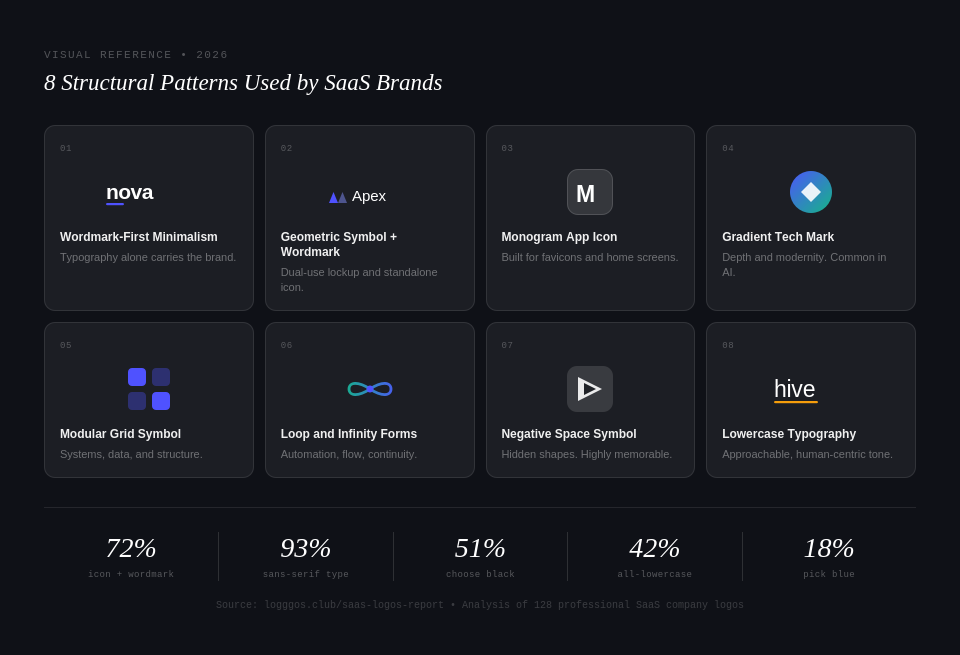
The illustration below maps all eight patterns with their key data benchmarks from the Logggos report:
8 structural patterns used by software brands in 2026, with industry data from the Logggos SaaS Logos Design Report.
Pattern 1: Wordmark-First Minimalism
What it is: The entire logo is typographic. A carefully chosen sans-serif typeface, sometimes with one or two letterform customizations, carries the full brand weight. There is no symbol.
Why it works: Wordmarks force clarity. When a brand is named something distinctive like Notion, Linear, Vercel, or Stripe, the word itself can become the symbol over time. Wordmarks also eliminate the classic early-stage SaaS problem of a symbol that means nothing to new users yet.
The key is the typography. Modern sans-serif fonts with geometric construction, balanced spacing, and minimal stroke contrast perform best here. Fonts like Söhne, GT Walsheim, or custom optical variants of geometric grotesques appear repeatedly in high-growth SaaS brand systems.
Subtle customization earns its keep. A slightly modified letterform on one character, such as a custom "a" or a notched "t", gives the word mark proprietary character without adding visual complexity.
Scalability notes: Wordmarks struggle at very small sizes unless they are short (three to six characters). Products that need app icon treatment alongside a wordmark logo should plan for a companion monogram from day one. Read more about the strategic difference in the wordmark vs symbol logos guide.
Best for: Early-stage B2B SaaS, developer tools, API-first platforms, productivity software.
Pattern 2: Geometric Symbol + Wordmark
What it is: A compact abstract symbol, typically built from basic geometric primitives (circles, triangles, rectangles, diagonals), paired with a wordmark at a defined scale ratio.
Why it works: The lockup gives you dual utility. The full lockup (symbol plus text) works for landing pages, pitch decks, and marketing materials. The symbol alone becomes the app icon, favicon, and avatar. This is the most common pattern among Series A and beyond SaaS companies precisely because it covers every surface.
Abstract symbols carry forward better than literal ones. A symbol shaped like a spreadsheet grid may seem clever for a data product today, but feels dated when the product expands beyond that use case. Geometric abstractions stay flexible.
Scalability notes: The symbol must work at 32x32 pixels. This is non-negotiable. If it loses legibility or distinctiveness below that threshold, the geometry is too complex.
Best for: Platform products, marketplace tools, analytics software, project management SaaS.
Pattern 3: Monogram App Icon
What it is: One or two initials set in a custom container shape (typically a rounded rectangle, circle, or square with specific corner radii) that mirrors app icon conventions.
Why it works: For products that live primarily inside operating systems, mobile home screens, or browser extensions, the app icon is the logo in everyday use. Treating it as the primary design artifact rather than an afterthought produces a dramatically stronger result.
The container shape matters as much as the letterform. Apple's Human Interface Guidelines and Google's Material Design both publish specific guidance on icon shape conventions within their ecosystems. Ignoring these creates visual friction on the home screens where your product lives. Read about how to use logo files in Figma to understand how monogram icons get implemented in design systems.
Scalability notes: Test the monogram at 60px (the minimum iOS icon size displayed in settings). Also test it inverted, light letterform on dark background and vice versa, as OS dark mode and notification contexts will trigger both.
Best for: Mobile-first SaaS, browser extensions, Slack or Teams apps, PLG (product-led growth) tools.
Pattern 4: Gradient Tech Mark
What it is: A symbol or wordmark that incorporates a color gradient, typically moving from one hue to a related or complementary hue, as the primary visual treatment rather than a flat color.
Why it works: Gradients communicate dynamism, modernity, and depth in ways flat color does not. Once stakeholders land on a direction, get the final mark and usage rules signed off electronically so the design system can move into production without a round of email chasing. They are strongly associated with innovation categories: AI, cloud computing, automation, and developer infrastructure. When SaaS brands do use color, the Logggos SaaS Logos Design Report found blue is the most popular choice at 18% of colored logos, chosen precisely because it signals trust and reliability, followed by orange (10%) and green (8%). Gradient marks that blend these trusted hues can capture both the credibility of blue and the energy of adjacent tones.
Subtlety is the differentiator. The worst gradient marks are high-saturation rainbow sweeps that look dated within two years. The best ones use a narrow hue range, say a move from indigo to violet or from teal to green, producing a sense of richness without visual noise.
Scalability notes: Gradients render differently across output formats. Always test in SVG (where gradients render from their mathematical definition) and in PNG exports at various sizes. Very small gradient marks can lose their color depth when rasterized at low resolution. Understanding the best logo formats for websites is essential before deploying a gradient mark across production surfaces.
Best for: AI tools, cloud platforms, fintech, no-code/low-code platforms, automation SaaS.
Pattern 5: Modular Grid Symbol
What it is: A symbol built from a visible or implied grid, with tiles, blocks, cells, or nodes arranged in a geometric matrix, often with individual units differentially colored or scaled.
Why it works: The grid metaphor resonates deeply with SaaS product categories built around data, structure, collaboration, and systems thinking. It visually communicates that this product organizes complex information. Companies building analytics dashboards, data warehouses, design systems, or workflow tools repeatedly return to this pattern.
The visual logic must be internally consistent. Modular grid marks that feel arbitrary, where the arrangement of tiles does not follow a clear visual rule, read as decorative rather than meaningful. The grid should suggest either the letter initial of the brand name or a recognizable geometric relationship such as symmetry, rotation, or layering.
Scalability notes: Grid marks can become visually muddy at small sizes if the gaps between modules are too thin. A minimum gap of 10 to 15 percent of the module width is a useful starting rule for favicon-safe grid marks.
Best for: Data analytics, dashboard tools, business intelligence SaaS, design systems platforms, collaborative document tools.
Pattern 6: Abstract Loop and Infinity Forms
What it is: A mark built around a continuous loop, infinity figure, circular path, or flow form, with shapes that visually suggest ongoing processes, automation, or recursive operations.
Why it works: The loop is a universally understood metaphor for continuity and automation. SaaS products built around recurring workflows, subscription logic, or automated pipeline operations find that loop marks communicate their core value proposition in the logo itself.
The execution challenge is differentiation. The infinity symbol and basic loop forms are extremely common in this space. Brands that win with this pattern typically distort, segment, or interrupt the loop in a distinctive way, using a break in the line, a dimensional perspective shift, or an asymmetric weight distribution to create a form that feels proprietary rather than generic.
Best for: Automation platforms, subscription billing tools, DevOps and CI/CD products, integration middleware.
Pattern 7: Negative Space Symbol
What it is: A mark where the meaningful shape, often a letter, arrow, or icon, is created by the absence of color rather than its presence. The white or background space does the visual work.
Why it works: Negative space marks are memorable precisely because they require a moment of visual discovery. The brain that finds the hidden arrow in the FedEx logo does not forget it. For SaaS brands, this double-reading property creates disproportionate memorability relative to logo complexity.
It is one of the hardest patterns to execute well. The negative space shape must be immediately legible to the majority of viewers without explanation, and the positive space container must read as a coherent geometric form at the same time. Most negative space attempts fail one of these two tests.
Scalability notes: Negative space marks require careful minimum size management. At small sizes, the negative space can close up and disappear, leaving only the positive form. Always specify minimum display sizes in your brand guidelines. See minimalist logos explained for a broader context on how simplicity and legibility interact.
Best for: Fintech, security SaaS, brand-forward consumer apps, mature platform products with budget for bespoke brand work.
Pattern 8: Lowercase Friendly Typography
What it is: A wordmark or logotype set entirely in lowercase, typically in a rounded or humanist sans-serif typeface, with the brand name presented without initial capitalization.
Why it works: Capitalization carries implicit formality and authority signals. By deliberately choosing lowercase, SaaS brands signal approachability, user-centricity, and the absence of corporate stiffness. This pattern is disproportionately popular among consumer-facing SaaS, productivity tools, and any product positioning itself as the friendly alternative to an enterprise incumbent.
The typography choice amplifies or undermines the positioning. Lowercase set in a rigid geometric grotesque reads as minimalist but still somewhat cold. Lowercase set in a rounded humanist sans-serif, with soft terminals, open apertures, and generous x-heights, amplifies the warmth signal. The two treatments serve different brand personalities.
Scalability notes: Lowercase wordmarks face the same small-size challenges as all wordmark-first marks. Ensure the letterforms are optically balanced and well-spaced before finalizing. Many lowercase SaaS marks benefit from tighter letter-spacing at display sizes and looser spacing at small sizes, which requires a responsive typography plan.
Best for: Consumer SaaS, wellness tech, HR tools, education platforms, SMB-focused products.
Typography Strategy Across All 8 Patterns
Regardless of which structural pattern you choose, typography decisions run through every SaaS logo. A few principles consistently separate strong outcomes from weak ones.
Avoid overused system fonts. Inter, Roboto, and Helvetica are workhorses of the web. They are readable and neutral. They are also used by thousands of SaaS products. Using an unmodified system font as a logo wordmark communicates that the brand did not invest in its identity, which sends a subtle but real signal about product quality to prospective buyers and investors.
Geometric and humanist sans-serifs dominate, for good reason. The data backs this up firmly: the Logggos SaaS Logos Design Report found that 93% of SaaS logos use sans-serif typefaces, with serif, slab, and script fonts being rare outliers in the category. Geometric sans-serifs (Futura-family, Circular, Gilroy) project precision, modernity, and confidence. Humanist sans-serifs (Myriad, Gill Sans, Brandon Grotesque) project friendliness, accessibility, and warmth. Matching your typeface category to your product's positioning is more important than the specific font choice.
On casing: the same report found 42% of SaaS logos use all-lowercase naming versus 48% using standard mixed case and just 10% going all-uppercase. The near-parity between lowercase and standard case reflects the ongoing shift toward more approachable brand voices across the category.
Custom lettering is worth the investment at Series A and beyond. Once a SaaS company has found product-market fit, a bespoke wordmark, even if it is only a handful of custom ligatures or modified letterforms on an existing typeface, provides proprietary visual equity that compounds over time.
Color Strategy for SaaS Logos
Color in SaaS logos is both a branding decision and a UI systems decision. The logo color often seeds the primary brand color that will appear throughout the product interface, in marketing emails, on pitch decks, and in customer-facing touchpoints.
Blue and its variants still dominate SaaS for structural reasons. Blue communicates trust, reliability, and competence, which are properties that enterprise B2B buyers weight heavily in vendor evaluation. The Logggos SaaS Logos Design Report confirms this pattern from the ground up: among the 128 SaaS companies analyzed, blue is the most frequently used color when brands go beyond black, appearing in 18% of colored logos. Notably, 51% of all SaaS logos in the study are black, reflecting how digital-first brands favor neutrality and maximum UI compatibility over color-driven differentiation.
Differentiating within a category requires moving off the obvious. If your three closest competitors all use blue, a distinctive purple, green, or even a warm amber may create stronger category contrast. Color differentiation is most impactful for brands entering crowded categories where visual distinction at the awareness stage creates real conversion lift.
Always define your logo in a theme-neutral primary. The full-color logo should work on white. Its inverted or white version should work on dark backgrounds. A mid-tone brand color (something like a medium blue-gray) that looks great on a white website often has insufficient contrast on a dark product dashboard. Build both versions deliberately, not as an afterthought.
Scalability: The Non-Negotiable SaaS Logo Test
A SaaS logo that does not survive the favicon test has a structural problem. This single requirement eliminates more design directions than any other.
The standard size checkpoints for SaaS logo testing in 2026:
- 16x16px (browser favicon)
- 32x32px (high-DPI favicon, small app tile)
- 64x64px (Slack workspace icon, browser extension icon)
- 180x180px (iOS home screen icon)
- 512x512px (app store listing, Google Play)
- Full lockup at 200px wide (mobile nav, email header)
- Full lockup at 400px wide (desktop nav, landing page hero)
- Billboard / OOH (for companies that buy physical advertising)
At each checkpoint, you are evaluating three things: legibility (can you read it?), distinctiveness (does it still look like your brand?), and balance (do proportions still feel right?).
If you are placing logos into presentations or documents, the complete PowerPoint logo guide and the print-ready logo setup guide cover format-specific requirements in depth.
File Format Requirements for SaaS Logos
The most technically capable logo design is only as good as its delivery format. SaaS brands need to manage multiple output types across multiple use contexts.
SVG is the master format for all digital SaaS logo use. Scalable Vector Graphics produce mathematically perfect rendering at any resolution, load efficiently in web browsers, and can be styled with CSS for dynamic theming. If your gradient logo needs to adapt between light and dark mode, SVG with CSS variables is the most elegant implementation path. Understanding the differences between SVG, PNG, and JPG is essential reading for any SaaS designer.
PNG is necessary for platforms that do not accept SVG. App store submissions, social media profile images, CRM tools, and most document contexts require rasterized PNG files. Export at 2x and 3x the display resolution to future-proof against high-DPI screens.
EPS remains relevant for print and vendor contexts. Many conference booth vendors, merchandise suppliers, and print agencies still require EPS files. Understanding EPS logo files and their use cases will save significant friction when your brand starts appearing in physical contexts.
Building a Logo System, Not Just a Logo
The most durable SaaS brand identities treat the logo not as a single mark but as a system of related assets that cover every deployment context.
A complete SaaS logo system includes:
Primary lockup: the full-color, full-name wordmark or symbol-plus-wordmark combination used on white or light backgrounds.
Reversed lockup: the white or light-on-dark version for dark UI, email footers, and dark mode contexts.
Symbol only: the icon or monogram extracted from the lockup for use as a standalone app icon, favicon, and social avatar.
Wordmark only: the name without the symbol, for contexts where the symbol has already established brand recognition.
One-color versions: black and white variants for contexts requiring single-ink printing, watermarks, or monochrome output.
Minimum size specifications: documented pixel and millimeter minimums below which the logo should not appear, with clear rules for which version to use at which size.
A well-documented system eliminates hundreds of small brand decisions over the life of the company and ensures that contractors, agencies, and partners always deploy the logo correctly. You can explore a full range of professionally organized logo assets at LogoToUse.
Implementation Checklist
Before finalizing any SaaS logo, run through this practical checklist:
Design phase
- Does the primary mark work at 16px (favicon test)?
- Does it work inverted on a dark background?
- Is a standalone symbol or monogram defined for app icon contexts?
- Is the gradient (if any) defined in SVG gradient syntax, not just as a raster effect?
- Are custom typefaces licensed for logo and web use (not just desktop use)?
File preparation
- SVG delivered with embedded fonts or outlined text
- PNG exported at @1x, @2x, and @3x for all variants
- EPS delivered for print vendor use
- All colors defined in both RGB (screen) and CMYK (print) values
Brand system
- Light background version confirmed
- Dark background version confirmed
- One-color black version confirmed
- One-color white version confirmed
- Minimum size specifications documented
UI integration
- Logo tested in actual product nav (desktop and mobile)
- Favicon uploaded and tested across Chrome, Safari, Firefox
- App store icon submitted (if applicable) and tested on home screen
SaaS Logo Design Patterns: FAQ
What makes a SaaS logo different from a traditional logo?
SaaS logos must perform across a much wider range of digital surfaces than traditional logos, from 16-pixel favicons to full-page presentations. They also need to function on both dark and light UI backgrounds, adapt to app icon constraints, and often integrate into design systems that control color through CSS variables. Traditional print-focused logo design does not fully address these requirements.
Should a SaaS startup begin with a symbol or a wordmark?
Most early-stage SaaS startups are better served starting with a strong wordmark. Wordmarks force clarity on the brand name itself, are faster to produce at quality, and create less confusion when users are still learning what the brand name is. As the product matures and the symbol earns recognition on its own, companies can introduce a standalone mark. The wordmark vs symbol logos comparison covers this decision in detail.
Are gradients still a good choice for SaaS logos in 2026?
Yes, particularly in AI, automation, cloud, and developer tool categories. The key is restraint: narrow hue ranges, consistent gradient direction, and careful attention to how the gradient renders across file formats and screen types. Broad, rainbow-style gradients read as dated; sophisticated two-color gradients with good hue relationships remain contemporary.
What font categories work best for SaaS logos?
Modern geometric and humanist sans-serif typefaces consistently perform well. Geometric sans-serifs project precision and technical authority; humanist sans-serifs project friendliness and accessibility. The right choice depends on your product positioning and target buyer. Avoid unmodified system fonts like Inter, Roboto, or Arial, which are too ubiquitous to create brand distinction.
How important is the favicon test for SaaS logos?
It is one of the most important practical tests a SaaS logo can pass. The favicon is the persistent browser-tab representation of the product and is often seen more frequently than any other brand touchpoint during active product use. A logo that fails to produce a legible, distinctive 16x16 favicon has a structural scalability problem that should be resolved before launch.
Should SaaS logos use lowercase?
It depends on brand positioning. Lowercase conveys approachability, informality, and user-centricity, which aligns well with consumer SaaS, PLG products, and tools positioned as alternatives to stiff enterprise software. Capitalized or mixed-case wordmarks convey more authority and confidence, which may be preferable for enterprise sales motions or security and compliance products.
How many color variants of a SaaS logo should exist?
At minimum: a primary full-color version, a reversed white version for dark contexts, a one-color black version, and a one-color white version. If the logo includes a gradient, a single-color fallback should also be defined for contexts where gradient rendering is unreliable (some email clients, certain print processes, monochrome signage).
Can a SaaS logo be too simple?
In practice, almost no SaaS logo fails from being too simple. The failures are almost always in the opposite direction: too complex to scale, too ornate to adapt across themes, too literal to remain relevant as the product evolves. Simplicity is a feature, not a limitation, in SaaS brand identity.
What file formats should a SaaS company request from its logo designer?
SVG for all digital use (primary deliverable), PNG at @1x, @2x, and @3x for raster contexts, and EPS for print and vendor use. All variants (light, dark, one-color black, one-color white, symbol only, wordmark only) should be delivered in each applicable format. EPS files explained covers the print format requirements in more detail.
How should SaaS logos be maintained across a growing team?
A documented brand system with named assets, defined minimum sizes, and approved use cases prevents logo drift as the team grows and contractors engage. Store all logo assets in a shared, versioned location and define clear governance around who can approve logo modifications. Design systems tools like Figma make this significantly easier to manage at scale.
Explore logo resources, brand assets, and design references at LogoToUse.
The logo ships with the product, not before it
SaaS identity work rarely happens in isolation. The mark, the marketing site and the first working build tend to land in the same few weeks, which is why so many software logos are designed against a live interface rather than a mood board. Founders compressing that timeline can follow Modulify's weekend playbook for building an MVP with AI, which covers getting a real product and its landing page live while the brand is still settling.
Read more
Subscribe to get fresh stories, tips, and logo resources delivered straight to your inbox.